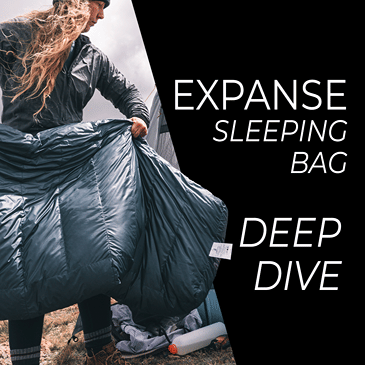
The Outdoor Vitals Expanse Sleeping Bag is a roomy, hoodless ultralight down sleeping bag built for side sleepers and anyone who moves at night. In this Live Ultralight Podcast episode, Tayson Whittaker and OV lead designer Brigham Crane cover the full design story, a couple years of prototypes and field testing, and every feature of the Expanse.
Expanse Sleeping Bag: https://bit.ly/4iJwgG4
Have questions for us? Send us a voice message on Speakpipe: https://www.speakpipe.com/LiveUltraLight Or write in to support@outdoorvitals.com!
"I just flat out had some of the best nights of sleep I've ever had in the backcountry sleeping in this bag." - Tayson Whittaker
CHAPTERS
0:00 Introducing the Expanse Sleeping Bag
2:16 The late night in the mountains that started the Expanse
7:03 Designing for sleep quality, side sleepers, and less fiddle factor
10:59 What people want from a sleeping bag: foot room and simplicity
13:13 Why the Expanse is hoodless
15:06 Half-length zipper and a roomier cut
17:32 Why 900 fill power Muscovy down
19:27 Extra room means cold spots: the interior cinch cord solution
23:16 Why a smaller space stays warmer: the heater analogy
26:07 Prototype one: what testers found
33:09 Refining the draft collar, zipper, baffles, and elastic cords
36:45 Why the Long size gets a third cinch cord
39:30 Top to bottom walkthrough of the Expanse
41:36 How roomy is it? Mild taper vs mummy and rectangular bags
43:37 Symmetrical design and top quilt mode
45:20 Field testing: warmth, simplicity, and sleep quality
52:30 Cold sleepers, kids, and friends in the Expanse
54:58 The tradeoff: about 5 oz heavier than a top quilt
58:20 Specs, weights, and 2027 temperature ratings
1:01:25 ExpeDRY down and 900 fill power explained
1:05:00 Wrap-up and how to send questions
HOW THE EXPANSE WAS TESTED
Through development, the Expanse was the design team's only sleep system, year round, in every condition. Every temperature rating was slept at and below its rating. In the 15°F model, Brigham only added extra layers once temps dropped to around 9 to 12°F.
EXPANSE SLEEPING BAG SPECS
Available now: 15°F comfort rating (comfortable at the rating, not survivable), Regular 72" (1 lb 13 oz) and Long 77" (2 lb), bag only
Coming in 2027: 30°F (1 lb 7.7 oz, Regular) and 0°F (2 lb 6 oz, Regular)
Insulation: 900 fill power ExpeDRY Muscovy down
Shell and lining: 10D nylon
DWR treated Zipper: half-length YKK No. 5 coil with draft tubes and anti-snag webbing
Inside width: 30" shoulder to hip, 27.5" at the knee, 13.5" minimum footbox
Room: about 50% more at the knee and 40%+ more in the footbox than some of our own mummy bags
Baffles: horizontal and vertical, with added baffles below the knee to keep down in place
Interior elastic cinch cords: 2 in Regular (knee and foot), 3 in Long
Cinchable draft collar, inner snap at the top of the zipper
Dry bag (1.5 oz) and storage bag (4 oz) included
EXPANSE SLEEPING BAG FAQ
Is the Expanse good for side sleepers? Yes. The Expanse Sleeping Bag was designed for side sleepers who roll through the night. The down is distributed symmetrically with no top or bottom side, so the bag stays equally warm wherever it twists or the zipper ends up.
How do the cinch cords inside the Expanse work? Thin elastic cords run around the inside of the lower bag. Cinching them shrinks the space your body has to heat, without squeezing the down from the outside. Most nights you leave them open. They are there for nights colder than expected.
Why is the Expanse hoodless? A beanie, jacket hood, or balaclava does the job with less weight, and lets you choose your head layer trip by trip. The hoodless, symmetrical design also lets you unzip the Expanse and drape it like a quilt on warm nights.
Expanse Sleeping Bag or a top quilt? At 15°F Regular, the Expanse is about 5 oz heavier than the StormLoft Down TopQuilt. Choose the quilt if lowest weight is the priority. Choose the Expanse if you want to crawl in with no pad straps, roll without any possibility of drafts, and have room to move. What is ExpeDRY™ down? ExpeDRY™ is a permanent nano gold treatment on the down that helps moisture evaporate faster, so the down keeps its loft through humid, multi-night trips.
Great Backpacking Gear (Support the Podcast): https://bit.ly/3PswpQi
[00:00:00] [SPEAKER_00] Hey everybody, welcome back to another episode of the Live Ultralight Podcast powered by Outdoor Vitals. Today we're going to be talking about a new product release over here at Outdoor Vitals. We have the Expanse Sleeping Bag. So in this episode, we've got Brigham, lead designer on the show to really walk us through the backstory of the product, what the product solves, why we developed it, and then get into the testing and launch of this product.
[00:00:24] [SPEAKER_00] So these are always super fun ones, highly listened to, and it's fun to just get into the nitty gritty of the products themselves. Obviously, since we're spending months and years in the design process of this, it's always fun to get things to the finish line, have the release, and get to finally share a lot more details with you guys. So Brigham, how are we doing today?
[00:00:48] [SPEAKER_01] Uh, I'm probably better than I sound. I'm a little hoarse and a raspy cough, but I actually am feeling better than I have been the last few days. So other than that, doing pretty well, finally stopped raining and... And snowing. Yeah. But yeah, it's good to be in the fall season.
[00:01:05] [SPEAKER_00] Yeah, we got the, um, the effects of the storms coming up through, uh, California and up into our neck of the woods. And it's definitely cooled things off a lot, added some snow in the mountains and, um, may change some plants for some of the company trips we were planning to do. We'll see if those are still going to be possible or not, but yeah, I don't know. I'm hearing rumors that it could be a, a wet winter and, uh, it's something we could definitely use around here. So we sure could.
[00:01:35] [SPEAKER_00] Okay. Well, man, the expanse sleeping bag. um, I think this is a piece that, I mean, I'm just excited because I think a lot of people will, how to say this? It's one of those pieces that at first you might not, not always realize, um, what you're missing out. And then you get this and you use it and you see how it all fits into the, to your system. And it's hard to unsee it.
[00:02:02] [SPEAKER_00] Like, it's like, for me, it's been hard to like, not just use it exclusively because of how much I personally enjoy the bag. And so, yeah, I'm, I'm excited to, to get into the nuts and bolts of this, but I guess to back up all the way back to the beginning of this, um, you know, what were some of those original questions that we started asking that pushed us into putting real time and energy and resources into this development?
[00:02:32] [SPEAKER_01] Uh, yeah, cause it, uh, the, uh, kind of the initial spark that got me going was more like kind of a singular frustration point, uh, that, but it, but it did, then it leads to other questions of, well, if this, then, you know, fill in the blank. If we're doing that, then fill in the blank.
[00:02:57] [SPEAKER_01] And, um, you know, it does lead to lots of questions that, that really kind of funnel into, you know, shaping the concept of any product. So, you know, uh, I had, uh, been on a, uh, multi-day trip by myself in the mountains and it was like the first night of the trip. I just was behind schedule and got into where I was going to set up my tent and go to bed late at night.
[00:03:23] [SPEAKER_01] So, you know, I kind of bypassed eating any dinner and was just feeling tired and, you know, that feeling of just wanting to go to bed and still hadn't eaten. So I just remember, you know, for me, I very consistent top quilt user, um, and very happy with, with our top quilt, um, for all the benefits for that a top quilt offers.
[00:03:46] [SPEAKER_01] But as I was, you know, I got my tent set up and I was blowing up my pad and then, you know, I get kind of like the shakes when I haven't eaten for hours. And it's like, you know, you spend a lot of energy. And so I'm up here up high in the mountains and it was well past dark, probably 10 PM or something like that.
[00:04:05] [SPEAKER_01] And I get my top quilt out and I, I was frustrated, you know, having to deal with, uh, you know, uh, you know, forgetting to put the straps on and then getting the straps on while I've got, you know, all my gear laid out in the tent. And, um, you know, the pad straps that connect to the pad and to the top quilt.
[00:04:24] [SPEAKER_01] And, and I, yeah, I was, got pretty frustrated and, um, just had, you know, the, the feeling and the thoughts that it's just like, I just wanted to go to bed and I just wish I could not have to hassle with this right now. And that was, um, that was a profound, uh, you know, thought process for me because I have always enjoyed using a top quilt.
[00:04:48] [SPEAKER_01] And, um, so I kind of dwelled on that and gave thought to why this one experience, you know, out of hundreds, um, is now leading me to think about this and what other, you know, why, why? It kind of is like pulling on threads, like, why am I feeling this way? And okay, if I'm feeling this way, is it, you know, like I'm a guy, I would say I'm a, my preferences are towards the top quilt.
[00:05:13] [SPEAKER_01] Um, but if I'm experiencing this, then it just started making me think about other people's preferences, what other people's, you know, you know, maybe, maybe physical ailments or just different ways that people might prefer to sleep. And, uh, I kind of just, the immediate thought was just like, okay, this is where a sleeping bag would be really nice. So I can just throw it down on the sleeping pad and crawl in and go to bed. You know what I mean? Like forget eating dinner, just go to bed.
[00:05:42] [SPEAKER_01] Um, you know, and that's, that's maybe a 60 second process, but tell you at that time when I was shaky and tired and wanted to go to sleep, like 60 seconds was making me pretty frustrated. So, um, you know, I thought, well, if, uh, you know, there's already sleeping bags out there, like that's not, that's not a solution. You know what I mean?
[00:06:05] [SPEAKER_01] It's just like an alternative, but if, you know, what are the other things, you know, sometimes got me thinking, what are, what are other things that maybe I've experienced from time to time, especially as I've gotten older, um, in top quilts. And kind of started taking mental inventories from things and started the thought process of, okay, if we're going to do something about this, if we're going to offer something that is an alternative to a top quilt for people with different preferences.
[00:06:32] [SPEAKER_01] Um, what type of preferences like sleep habits, like that's a big one. I'm a side sleeper. I toss and turn a lot. It's never been a problem in a top quilt, but you know, we do hear from people that for whatever reason, top quilts don't work for them. That's fine. Um, and some people just sleep differently and just started asking those questions like what, what are people's sleeping behaviors? Um, okay. So then what does that mean for this thing that we're going to create? Right.
[00:07:03] [SPEAKER_01] And, um, obviously the whole objective is to improve the people's experience in the mountains, especially their sleeping experience.
[00:07:12] [SPEAKER_00] Yeah. I mean, that's been a topic that me and you have talked on and off for the last couple of years. We talk like, you know, per on a personal level, we've kind of talked about like, man, like been struggling to get better sleep. You know, we get a little bit older and maybe we're more finicky with our sleep. And then, you know, for, for us, we spend a lot of nights in sleeping bags and tents and top quilts every single year. Um, you know, usually 30 plus nights a year.
[00:07:38] [SPEAKER_00] And so when you start factoring that in, it just, if you're not getting really good sleep in the back country, that starts to add up. And so we just kind of have had conversations. We've, we've had a lot of conversations around trying different pads out, but have hit the market and be like, oh, you know, this thicker pad or this. And, and just trying to dial in a few things to get like really maximize sleep. You know, there's sometimes it's all about maximizing weight.
[00:08:01] [SPEAKER_00] And sometimes you start to realize that maximizing quality sleep or, or another aspect of, of the trip can, can start to rank higher in your list of priorities. And so we've talked a lot about sleep quality, sleep quality. And then we kind of came into this, this thing of like, man, how do we just, what, if we were going to design a bag that was specifically built for like the maximum sleep quality in the back country, but we're ultralight backpackers. Like what could that potentially look like?
[00:08:28] [SPEAKER_00] And, you know, mixed with, with, you know, our, you know, sometimes you don't want to fiddle with pad straps or, or just sometimes you just don't want to draft, you know, when you roll over from the, from the data I've seen, most people are side sleepers, which means you're, you're rolling from one side to the other. And, um, and a top quilt, you know, there's, there's concerns with that, um, where you can get a draft or, you know, you're, you're adjusting pad straps and, and things like that. So that was kind of the premise of this. It's like, man, how do we just get the best ultralight sleep in the back country?
[00:08:58] [SPEAKER_00] Less, the least amount of like fiddle factor, the least amount of, um, potential things to have any concerns about. Yeah. And, um, so we started, started drawing out more ideas.
[00:09:11] [SPEAKER_01] Yeah. It's like, I mean, I was just thinking about budgets and like how some, so often some of these decisions are very similar to budgeting, but like, I just thought like, okay, what are the, the, the, the bear, like the, the most bare bones conceptual things is just like something simple. Cause that was the pain point that night, like just simple, thoughtless, spacious, comfortable, and, you know, lightweight, you know what I mean?
[00:09:40] [SPEAKER_01] And so like if you strip everything away, like that's what we're kind of going after. And then, but then that, that leads to questions that lead to decisions. Um, and yeah, kind of going back to like budgeting, it's like, well, it's not unlimited spending. So it's not just, uh, you know, that this sleeping bag can have all the things and be, you know, so big and, and, and certain things like that.
[00:10:05] [SPEAKER_01] You, we wanted to make every decision be calculated and, uh, essentially have just such a simple, comfortable, spacious sleeping bag that we could still feel good about taking on any trip because it was not heavy because it was very, um, deliberately designed to, to still minimize weight everywhere.
[00:10:33] [SPEAKER_01] Where we could buy while offering all of those things.
[00:10:36] [SPEAKER_00] Yeah. So we, we kind of knew we wanted to, to dabble in the sleeping bag world and see what we could, we could spin up. Right. So, um, maybe just kind of list off some of the thought process of like, okay, well, what are, what are some things we want to test? What are some things we want to try where we could take a sleeping bag, keep it super light, but add in, you know, the lack of fiddle factor and add in better quality of sleep. Yeah. Um, well.
[00:11:02] [SPEAKER_01] Well, I mean, one of the, one way that, you know, one of the ways that I, I kind of looked at it was, well, what are some things that we hear from people? Uh, because we don't come from a place of the top quilt is the only acceptable sleep system on the planet and it will suit everybody's needs. That's just our, the top quilt is one offering that we have. Right.
[00:11:24] [SPEAKER_01] So from the people that we listened to that maybe have some feedback on the top quilt that we offered, you know, sometimes that's, they, um, would prefer more room or like in the foot box, more leg room. They'd like to be able to spread their legs out a little bit. Um, you know, kind of sprawl it within the sleeping bag a little bit.
[00:11:43] [SPEAKER_00] Um. From an approachability standard, we hear those things a lot. In fact, it's almost clockwork that when we bring in maybe someone new into the office and we bring them out on a trip, they almost always take a sleeping bag on their first trip. You know, and it's, it's just because it's approachable. It's, it's like, there's less concern. There's less, you know.
[00:12:03] [SPEAKER_01] Less to think about.
[00:12:04] [SPEAKER_02] Mm-hmm.
[00:12:05] [SPEAKER_00] They feel more secure in it kind of thing.
[00:12:08] [SPEAKER_01] Yeah. Um, you know, another, and then like in, like my own personal experience every once in a while, and especially, you know, the more recent years, uh, every once in a while I'll get, um, you know, my hips will feel tight.
[00:12:25] [SPEAKER_01] Like when I'm in the middle of the night when I sleep, um, that, so that kind of got me thinking about how spacious can we make this thing and still, um, you know, keep it, keep it very reasonable, keep it very lightweight. And, and that, that leads to decisions, other decisions to make.
[00:12:44] [SPEAKER_01] Like, well, if we're going to just kind of really blow this thing up in the foot box or make it really spacious, well, that's all, you know, more fabric, uh, more materials, more down that's going to have to go in there to fill in that space. Then, then what do we do then so that this thing just isn't getting out of control? Right. Like it's just not, you know, it's not adding ounce after ounce after ounce.
[00:13:08] [SPEAKER_01] It's, you know, let's add a little bit and where can we mitigate or reduce weight as much as possible. And, and one of those things was like, Hey, like if we know people love top quilts because we love top quilts ourselves and we sell a lot of top quilts and it doesn't take much time to just kind of do a little bit of research on the internet to see that a lot of ultra light backpackers are using top quilts. You know what I mean? There's plenty of data out there.
[00:13:37] [SPEAKER_01] So one of the characteristics of a top quilt that people obviously like is that it doesn't have a hood, you know, their top quilts in and of themselves are pretty unrestricted because of that. Like they're open on the bottom, they don't have a hood. Um, and so like that was an area that I thought, Hmm, maybe that's, maybe that's a place where we can mitigate some weight and materials is this thing doesn't necessarily have to have a hood. Is it, could we get a good quality of sleep?
[00:14:05] [SPEAKER_01] Could we have tons of room in the sleeping bag and still be warm and comfortable without a hood? And so that like really entered the equation seriously. And that was like, I mean, that was the first prototype was that way.
[00:14:18] [SPEAKER_00] Yeah. Yeah. I mean, once you've slept without a hood, you've realized, I mean, in my opinion, it's like, I, I enjoy not having a hood because then I can just do exactly what I want for my head because trips are different. Sometimes I want a beanie. Sometimes I want nothing. Sometimes I want a full balaclava. And because of using top quilts so much, you've like, that's been in the equation for a while now.
[00:14:42] [SPEAKER_00] And there, and it's much more efficient to use a balaclava than to build an entire hood for the one time you might want to cinch it down. If that makes sense. It's, it's cheaper, it's lighter. It's, it's just. Yeah. So, so that made a lot of sense. So the very first prototype were like, you know, let's, let's skip the hood. I think, I mean, we can circle back to all the benefits of that later, but so that was one of the original things we wanted to try.
[00:15:06] [SPEAKER_00] I mean, on those first prototypes too, like started with, you know, less zipper than some sleeping bags out there. Yeah. We wanted to mitigate zipper weight. Yeah. Um, but we also, you know, cause we wanted a, we wanted a more roomy bag. We wanted the ability to spread, move. Um, and so, yeah, we're looking, we're looking at these potential trade-offs.
[00:15:30] [SPEAKER_01] Um, it's kind of like, maybe like just like sort of bridging the gap between maybe somebody that is familiar with using a top quilt and then changing to a sleeping bag because maybe they're like me and they're getting older. And every once in a while their hips get tight, uh, just for whatever reason, they might have had an okay or good experience with the top quilt, but their circumstances change and their preferences might change. Their sleeping behaviors might change.
[00:15:54] [SPEAKER_01] And so maybe we can bridge the gap and have some, some like top quilt elements to it, but bring in some of the simplicity we're after and spaciousness.
[00:16:04] [SPEAKER_00] I mean, one of the issues I have is like, I've, I've learned obviously to sleep in mummy bags and top quilts. And I, and I, and I do say I learned to, because, you know, when you first start doing it, you don't necessarily love it. You don't necessarily feel as comfortable, but some of the experiences I've been having is that like, I've had a lot of situations where it's too hot.
[00:16:28] [SPEAKER_00] Like it's getting too hot and with the, whether it's top quilt or a mummy bag, one of the ways that you can cool off a little bit is just spreading out your limbs a little, spreading your legs a little. Cause like you get really hot down there on your legs and your, your groin area. And if you can't really spread your legs at all, that's a, it's a point of discomfort.
[00:16:46] [SPEAKER_00] And, and I mean, it's part of why I like in our highline thermals, we use like a mesh on the inside of, of, of the crotch area, because that's an area where you really want to vent, especially if you're sleeping a lot in, in those kinds of thermals. And so, yeah, having that space, um, gives you some level of flexibility still, um, that, that sometimes on a trip just is the difference between. It's just a little hotter than we planned.
[00:17:10] [SPEAKER_00] And, and now I'm trying to like figure out the best way to vent, but not vent too much to the point that I might get cold or just some, just some things like that too. But so we've, we want a spacious bag, wanted something that was, you know, a sleeping bag. So we didn't have other potential things to fiddle with or, or concerns there, but we are ultra light backpackers. We want this to be as light as possible.
[00:17:35] [SPEAKER_00] And we have, you know, recent, a little bit more on the more recent years, been starting to dabble with, um, Muscovy down and the ability to move to eight 50 and 900 fill power downs. Um, and so it made a lot of sense for this product too, to be like, man, we're adding materials, we're adding size. And so let's, let's try this in a, in a 900 fill power product as well. Yeah.
[00:18:01] [SPEAKER_01] Yeah. I mean, cause the sleeping bag has to keep us warm for the conditions that we're in. So you make a sleeping bag bigger, you need to put more down in it. More down equals more weight. Um, and you know, in our current and previous sleep systems, we've, we've used 800 fill. Power down forever. Um, and it's, it's great product, but again, we're trying to, we're trying to add and then take away where we can. So made it bigger, wanted to make sure it's warm enough.
[00:18:31] [SPEAKER_01] And so we need to put the right amount of down in it. And we want it to then offset the additional down by the, by, by putting a higher fill power down in it. So we didn't necessarily need to put a substantially larger amount of down in it. We get the same amount of warmth for less down. So yeah, the choice to use a 900 fill Muscovy down and Muscovy down, we have just been impressed with. We, we use it in, uh, other, like one of our jackets.
[00:19:01] [SPEAKER_01] Um, and, and we've, we have tested it obviously in this, uh, the, the expanse for a couple of years now. It's, it's great. So that was, that was a very appropriate choice for, for this piece.
[00:19:15] [SPEAKER_00] Yeah.
[00:19:16] [SPEAKER_01] So I guess just kind of moving this story forward, we get to first prototypes and, um, well, I guess the other thing is just like, okay, well, if you make, if you create more room in the sleeping bag, you can't just offset that by putting more down in it. Uh, essentially. Right. Like that, there's no amount of down you can put in, in a sleeping bag that will just fill in actual empty space. Right.
[00:19:43] [SPEAKER_01] So from, let's say like, I don't know, like the mid thigh or the knee to the end of the foot, it's substantially wider than the RTOF quilt, most sleeping bags, I would say. And so that is all space that we need to make sure can keep the sleeper warm. So, um, the, the body is the heat source. And if you have too much space, um, those become cold spots, really.
[00:20:10] [SPEAKER_01] They become, uh, there's room for air to move around and draw heat away from our body. And so, uh, we needed a solution for that. Let's say essentially for conditions where the temperatures maybe got colder than expected because we're putting the appropriate amount of down for the size of the foot box and the intended temperature ranges.
[00:20:34] [SPEAKER_01] But if the temperatures again, we're just colder than expected, then the amount of down would not be adequate. And so then like thinking ahead, well, what do we do then? And I think that's where you were going is like, that's when we decided, okay, what if we can just kind of reduce some of the in the average internal volume in that lower half of the sleeping bag?
[00:20:56] [SPEAKER_01] If we can just reduce the average internal volume, you know, I don't know, like say what, 10, 20% maybe like that's that, you know, will help or mitigate that extra space. So what if we can just kind of take up some of that extra space? So when it is colder than expected, then, you know, problem solved. Um, and so that solution was, well, how do we do that? How do we do that with the highest probability of success?
[00:21:25] [SPEAKER_01] And the, the factor there is like, well, if you're going to reduce the internal volume via adjustability, we don't want to be compressing the down. Cause that would be counterproductive. It would basically cancel itself out. So you don't want to just say, oh, well, just put some cinch cords on the outside and cinch it down. Um, because that compresses the down from the outside and, you know, reduces the loft measurement essentially. So the, the down really isn't doing much for you.
[00:21:53] [SPEAKER_01] So, uh, yeah, we just designed it. So there were a couple internal cinch, uh, cords that go all the way around the inside layer of the sleeping bag. So as you cinch them down, they're just, uh, taking up some internal volume. And I'd say, like, I wouldn't say a hundred percent. It eliminates any potential compression, but it, it, it's almost a non-issue.
[00:22:22] [SPEAKER_01] You gain more warmth by bringing in the internal volume than you lose by the tiny margin of down compression. Because it's just, yeah, it's like constricts a circle from the inside. And so everything on the outside just kind of follows it. And that, that loft level pretty much stays the same.
[00:22:40] [SPEAKER_00] Um, so yeah, we did that. Yeah. I mean, I think, so this is actually an interesting thing because for many, many years, um, we've bounced around ideas of like expanding and contracting sleeping bags. Um, and how we could potentially do that without any compression of, of insulation or as minimal compression of insulation as possible. Um, in fact, I dug through some of the archives. One of the very, very first things that Brigham ever worked on was this sleeping bag that, that had some adjustment from underneath.
[00:23:08] [SPEAKER_00] I mean, it's a whole different product, but the concept was the same that you could expand a sleeping bag when you just want the most amount of space. But if it's cold out, you can shrink the size of that sleeping bag and, um, therefore make it more thermally efficient. One of the examples I like to give to try to illustrate this is let's say you have the same size of heater, um, puts off the same amount of output. And that is, you know, that is your body in a situation, but let's say you're in your house and you've got a heater.
[00:23:36] [SPEAKER_00] If you want to heat up, if you want to stay warm, do you take that heater into the largest room in your house, your family room and turn it on and try to heat up your entire family room? Or you take it into the smallest room in your house and turn on the same heater, same heater, but you're going to heat up that small room. Even though this, this house has the same insulation around the entire exterior, um, by taking it into the smaller room, that heater can actually have an impact and heat up that small room versus trying to heat up your entire family room with some little heater. Right?
[00:24:02] [SPEAKER_00] So that's the concept is if we can shrink the internal size of the sleeping bag, it's more thermally efficient. It's less space to heat up inside of there. And so that was the goal is, okay, well we want the most comfortable sleep in the back country, which means we want the space. But I can tell you from experience when it is cold outside, you are not spreading out in your sleeping bag. You are like shrinking up, you're wadding into a ball almost.
[00:24:28] [SPEAKER_00] And so we wanted just the ability for the bag to expand, contract and, and adapt to conditions. And so we, we came up with this, this concept of this inner draw cord system that is extremely light, but gives you that ability to come to pull in the inner, the inside of the bag tighter to you and has almost no down compression.
[00:24:51] [SPEAKER_00] Um, now you can get some down compression, especially if you are like pulling a ton of volume out of the inside of the bag. You start to see it like, and I, you may even see a video or excuse me, a picture or something like that from us where we've turned the bag inside out and tried it like, cause it's a hard thing to showcase. Or we pull them extremely tight. You might see a little bit of dimpling or something like that on the outside of the bag, but overall you can really shrink a ton of space out of the bag with, with no compression in the way that we've done it.
[00:25:19] [SPEAKER_00] So it was a way, I mean, super happy with, with that, but that was something that was, I was in the original proto too, right? Yeah. First prototype.
[00:25:27] [SPEAKER_01] I mean, yeah, especially, and it's a good thing cause the first prototype was huge. Oh, it was way bigger than it ended up being. But, uh, yeah, that was, I mean, that was the concept is if we're going to add this extra space, we want to have some margin for error and the temperature range. Like, just like I said, that, uh, that could be a really easy adjustment for somebody to make. And yeah, it would just reduce that internal space and help, help them stay warm and sleep well.
[00:25:57] [SPEAKER_00] Yeah. We've gotten used to having some adjustability and a top quilt. And so coming back to a different type of bag, we, you know, we didn't, we just want to give that up. And so, yeah. So we, we, um, yeah, we sample this thing, we get it, we, we build one and, or a couple and take them out there. And, um, yeah, well, we're, I mean, how, how do you feel like that the process went from there?
[00:26:20] [SPEAKER_01] Uh, you know, I think it was, uh, it, it, it, it went well because it was kind of like, uh, let's just see how this goes. Um, and see if this has validity. And, uh, yeah, we, we did. And, and we even had some external help in, in this, uh, just so we could get more people sleeping in it, like right away. Um, and that was really the, the number one question is, is, does this entire concept have validity?
[00:26:49] [SPEAKER_01] Uh, are we comfortable? Is it simple to use? Are we sleeping well in it? Is it warm enough? The warm enough thing, um, is generally a pretty simple fix. It's either you reduce the internal volume or you put more down in it or both, you know what I mean? And so, I mean, the first prototype, like I, like I just mentioned, like it was, it was very wide. I, I started out with that kind of like, this is the upper limit. Like this is, let's just bracket this process.
[00:27:16] [SPEAKER_01] So start with the widest foot box that I think you would possibly find reasonable and go from there. And after the first prototype, it was like, okay, I think we could make this a little, a little more tapered. Um, cause it was, it was really, it was very large.
[00:27:33] [SPEAKER_00] Um, yeah. What did some of those initial testers, you know, external testers have to say, I guess, when they got their hands on it?
[00:27:41] [SPEAKER_01] Uh, essentially, you know, that the, that the, the simplicity, uh, concept was, was valid. It was, it was simple to use. Uh, and, and one of the things in that simplicity that, that I wanted to do from the, from the get go was make it. So this, that doesn't matter what, which way is up, you know, there's no top side or bottom side. So from top to bottom, the down is going to be distributed the same way.
[00:28:11] [SPEAKER_01] So it like, again, I was, I would just rewind to that experience. Well, I don't even want to think about, did I put this on the sleeping pad correctly or not? Um, or, or any of that. So just put it down whichever way it falls and you're going to be equally warm either way, you know, or what if the vestibule is on the other side? Like just things like that were, um, making that simple. So that I'd say the, the feedback there was, was positive. Uh, it was validating.
[00:28:41] [SPEAKER_01] Um, the, I'd say the, the down chamber layout, um, was, um, was new, a little bit new for, uh, you know, compared to some other things, but it was kind of a carryover from how we've done our, our recent top quilts. Um, so making sure down is keeping us warm, staying where we want it to. Um, that was good.
[00:29:07] [SPEAKER_01] The, uh, you know, the internal draw cord thing, it was functionally, uh, worked, functionally worked. We learned some things like, uh, even in its most relaxed or. Unretracted, uh, position, uh, the initial draw cords were, were too thick in that if you moved around and your, your leg, your knee just even bumped that draw cord channel,
[00:29:36] [SPEAKER_01] you would feel that like almost solid tension of, of the internal draw cord. So, um, we immediately changed that to an elastic one and, but we, you know, refined that further over different iterations. But that was like one thing that, that stood out. I was like, oh, okay, we need, this is, it works, it functions, but it needs refinement. Uh, we don't want it to be a distraction. Uh, distractions, even in sleep or subconsciously lead to disrupted sleep.
[00:30:07] [SPEAKER_01] Um, the, yeah, the foot box was very large. Uh, you know, I think some of the external feedback was that it was, uh, that it did end up being a little colder than expected. And they noticed some, you know, issues with, uh, you know, not being quite warm just cause it was just so big. Um, let's see. I mean, those are the main ones.
[00:30:31] [SPEAKER_01] Uh, and the, the, uh, one thing we really also learned on that first one, uh, towards the top of the sleeping bag or the, the head area of the sleeping bag, it tapers. And that first prototype tapered very dramatically. Um, and the purpose of that is so, um, it just essentially preemptively cinches the, the, the, the top of the sleeping bag. So you're not actually having to cinch it.
[00:30:58] [SPEAKER_01] It just makes the opening smaller, uh, because you're going to cinch it up anyway. So removing some of that weight of materials and then it also helps the sleeping bag just kind of hug you around the neck a little bit, but it was, it was too narrow at the top. And that, that really narrow turn where the zipper, you know, comes up above the shoulder towards the head.
[00:31:19] [SPEAKER_01] It was a very tight turn and it, it, uh, you know, it made the zipper difficult, um, to manipulate from the inside to, to like get fully zipped up because it would kind of catch on that curve point. So yeah, we learned a lot from that first prototype.
[00:31:36] [SPEAKER_00] Um, I mean, I remember, and this is a while ago, so it's, you have to go back and really think. Think back there. But I mean, and the biggest thing I remember is getting in it, sleeping in it and being like, wow, this has potential. Like I, like it, it was just such a different experience, um, that it was, it was, um, yeah, it was kind of eyeopening where, cause, because in reality, because we did start it off with light wind materials and 900 fill power out of the get go.
[00:32:05] [SPEAKER_00] It was like, man, this thing compresses like as well as about my top quilt feels like it does, like in terms of size and space. But getting in that bag, you're like, dang, this is for a lot of the word that comes to mind is like luxury, you know? Cause like, you're just like, wow. You know, you really spread out and after being, you know, a lot of years and top quilts and mummy bags, it was, it was just like, it was a different thing to experience in the back country. Um, so I was, I was really excited.
[00:32:34] [SPEAKER_00] I mean, from proto one, I was like, this is exciting. This is, this is what we, you know, it's kind of, sometimes you get a first proto back and. You know, it's, it's a flop, you know, and, and sometimes you get a first proto back and you're like, yes, this has some meat on the bones here. Like this is, this is exciting. And I, I was my biggest takeaway. I do remember, I do remember the top taper being tied and the zipper being, um, you know, a little bit different in work and I, and, and some of those things.
[00:33:03] [SPEAKER_00] But, um, yeah, I just remember being at least pretty dang excited for a proto one. Yeah. Yeah. So, um, I mean, from there, obviously it becomes a game of, of refinement and, and proof, you know, like refine it and then just get nights in it and refine it and get nights in it. So, um, I guess from that, that process, what were more takeaways or more things to, to tell in this story of how this product came to be?
[00:33:30] [SPEAKER_01] Yeah. I mean, uh, it, it's nice when a first prototype tells you like almost every design element we can keep, it just needs to be refined. And that's actually a very motivating situation to be in. Cause it's just like, you know, every little thing, every single thing that you need to tweak. Mm-hmm . And like now you're just envisioning, okay, well then this has six improvements that we can make.
[00:33:59] [SPEAKER_01] And that means that this thing is going to be better the next time. And the next time, and the next time you can kind of see where it's going to end up and it's, it's, it's pretty energizing. It's, um, you know, so improving, uh, really refining and finding a really optimized balance of the taper towards the top. So the zipper runs smoothly and there's no abrupt curvature or anything. It's a very gradual curve.
[00:34:21] [SPEAKER_01] Uh, we dialed in the, the neck collar, the, you know, the collar, the draft collar, um, making it bigger, making sure there's a appropriate amount of down inside the collar. Um, changing the, the, the, basically the construction of what seems it's sewn into so that it is more oriented into the neck versus up to the head. Oh yeah, that's right.
[00:34:46] [SPEAKER_01] And that, and then combining that with making it like a four inch, uh, draft collar, um, it's just does a, such a, such a better job at, at sealing up, you know, the neck area and, and, and retaining heat.
[00:34:59] [SPEAKER_00] Especially without feeling like you've got to have a cord pushing against you. Right. Right. Cause that's, that's one negative experience that, that I've had too, is when you've got to cinch things up and it's like, you feel the cord cinched against your body or, you know, when you've got this big of a draft collar. That we kind of refined, um, you don't have to cinch it like so tight that it's, it's uncomfortable.
[00:35:23] [SPEAKER_01] So yeah. Um, over iterations, you know, we, we changed, we added a couple more baffle lines to, to contain the down a little bit, uh, below the knee. Um, you know, uh, on the, the zipper draft tubes, having a wide, excuse me, having a wide, uh, like anti snag webbing that runs along the zipper track.
[00:35:49] [SPEAKER_01] Um, dialed that in, um, the, the internal draw cords. So we mentioned we moved to elastic. Um, but as we did that, then we just shrunk the elastic. So a very, a very thin elastic cinch cord. Uh, so again, we like it's only purpose just needs to cinch up the inside. It doesn't have to handle any load, any stress, you know what I mean? So the thinner it is, the less likely it is to bother anybody.
[00:36:16] [SPEAKER_01] And the easier it is to, to stretch if, you know, in the event that, you know, a leg does push up against it. It's, um, you know, we dialed, we dialed that in. Um, I, I feel like once, man, I, even on the second or third prototype, we, we got the foot box width, the dimensions, like where we want it. We didn't even need to touch that for probably like the next three to the final iteration of prototypes. Like that was, that all was just fine.
[00:36:45] [SPEAKER_01] Um, we did learn like on the long models, cause we have regular and long models. Well, you know, uh, persons, if somebody is in the long model, their legs are quite a bit longer than the average person for the regular model. So, um, looking at the sleep quality and the space that they had to keep warm with their legs, uh, we did add a third cinch cord on the long model just for those taller people.
[00:37:10] [SPEAKER_01] Um, instead of just the, the one kind of at the knee area and the one at the foot area.
[00:37:15] [SPEAKER_00] I think that's, I think that's important too, to highlight. Um, when, you know, as a taller person, you, you typically have longer arms, you know, longer legs and extremities are hard to keep warm. Um, I think if you really start to pay attention, you'll find that a lot of people with that are taller or at least have like, like longer arms or longer legs, they struggle with keeping their hands or their feet warm or things like that.
[00:37:40] [SPEAKER_00] And so, um, having that I think is super helpful because, you know, for me, this hasn't been an issue for years. I feel like we really like have nailed the amount of down putting in foot boxes and stuff like that. But for so many years, I just all like, I would always have cold feet. You know, they felt like, um, I'm talking back like 2015, 16, 17, and, you know, times like that. Um, you know, we created down booties because I just constantly felt like my feet were colder than most people's.
[00:38:11] [SPEAKER_00] And so when you come to a longer bag like this, um, having the ability that the expanse has, I think is just super helpful for, for tall people too. So something to note, you know, it's because one thing that, that, that you'll notice is that we have those adjustments are really, you know, in the lower half of this bag, not so much up around the upper half of this bag. And sure, you do get some, you know, some, some compression and reduced volume by cinching up the neck area.
[00:38:38] [SPEAKER_00] But for the most part, most of your vital organs and your heat and your blood flow and things like that are right there in the core of your body. And so the first thing that starts to usually get cold, if you're pushing limits on a bag is going to be, you know, your, your feet and your, your legs and, you know, kind of going away from your, your bigger center of mass. So, um, just something I guess to note there, but I definitely, um, appreciated adding in that extra draw cord on, on the long model.
[00:39:06] [SPEAKER_01] Yeah. Um, yeah, I mean, it's just, it's just the whole, yeah, I feel like it just was, I don't want to say it was just like a simple and easy. Uh, but the whole process was just honestly, just every single like design element stayed on its path. Like went down the track that it originally started just more and more refined. Yeah.
[00:39:30] [SPEAKER_00] So let's, let's, uh, let's touch on anything that we haven't yet touched on. So top to bottom here in the bag, we've got nice draft collar, um, goes all the way around, you know, the neck area. Yeah. And then you've got the ability to cinch that tighter or leave it fully loose. You've got, um, an inner snap to be able to hold the very top of the zipper together. If you, if you need or want to use that. And then you've got a zipper. The zipper is, I think we call it a half length zipper. We call it a half length. Yeah. Yeah.
[00:40:00] [SPEAKER_00] So it doesn't go as deep into the foot box and some benefits of that, right. Is weight. We save weight by not having an extra long zipper or something. And then warmth zippers, you have to insulate those. And so it's not just the zipper weight, but it's the draft tubes that have to follow that. And then, you know, you know, to properly insulate it, but then there's still just always the potential of, of, um, it not being as insulated as the rest of the bag.
[00:40:29] [SPEAKER_00] And so by doing a half length zipper, we keep the bag really warm. We reduced weight on the bag and, um, you know, we want it with, with the extra knee room too. It just wasn't as hard to get in and out of the bag with, with out having an extremely long zipper. Um, and so, yeah, really, really enjoyed that. So we've got the zipper, um, we dialed in those baffles and you'll see it's a, it's more of a unique baffling system. We've got horizontal, we've got vertical baffles, um, so on and so forth.
[00:40:59] [SPEAKER_00] And then you get down there, like, right, you know, basically where the zipper's ending and you're starting into the, the thigh and knee and feet areas. Um, then we've got some of these expandable inner elastic draw cords. Um, for the most part, I don't know, I'll just kind of say this for the most part. You don't touch those. Like you can leave them fully open. Really. It's just when you're getting into the edge case scenarios. And so for the most part, you're using this bag fully wide open all the time. It's warm.
[00:41:27] [SPEAKER_00] It's adequately, um, insulated and, and you just get to experience the whole roominess of the bag. Um, in terms of just like some, some numbers here and numbers, numbers don't tell the whole story because numbers really like a comparison numbers is only valid to what it's compared to. But when you compare it to even some of our own mummy bags and things like that, like you're talking in the, in the knee area that you're getting 50% more room than the foot box.
[00:41:56] [SPEAKER_00] You're getting, you know, 40 plus percent more room. So it's a, it's a very noticeable amount of additional space. And when you look at the bag, you know, you'll, you'll see it, you'll see that it doesn't have the traditional tight mummy look to it. Yeah. It does not.
[00:42:11] [SPEAKER_01] I mean, it, I just call it a mild taper, uh, because it's, if, if the definition of a mummy is that it's narrower at the bottom than it is at the top, then yeah, it's a mummy. Um, but ours is tapered at the top too. So, but if, if the, from the shoulder to the foot box, yes, it, it narrows down, but it's compared to a, a standard mummy shape. It's, it's much more mildly tapered.
[00:42:35] [SPEAKER_00] Yeah. And what I've, what I've experienced with that, because in the past we have had rectangular bags specifically in like our airy sleeping bags. And even before that, we had one call an explorer. But I mean, for me, I never, you never can use the edges of a corner sleeping bag. Like you can't stick your foot down in a corner really well. You know, you don't ever really want to point your toe into a corner because that's like the coldest spot in the bag.
[00:43:01] [SPEAKER_00] And so I equate sleeping in this bag to almost the same feel as sleeping in a rectangular style sleeping bag versus a mummy style sleeping bag. Right. In terms of actual real life use, if that makes sense. Like if I was to go pull one of our old airy products and pull this, I would feel like they have the same amount of room. Like usable space. Yeah. Just without the inefficient use of space. Yeah, exactly.
[00:43:29] [SPEAKER_00] So it sleeps more like a rectangular bag to me with this mild taper that, that Brigham, you know, just, just mentioned. Um, the bag itself is symmetrical and that was by design. You know, originally it was part of the concept there was, you know, we can flip it and put the zipper on one side, flip it, put the zipper on the other.
[00:43:49] [SPEAKER_00] But we always also had ideas and we got to test this that you could unzip the entire bag and basically use it in what we call top quilt mode. Where you could leave the zipper fully unzipped and you could put your feet in it just like a top quilt and you could lay the bag on you more like a top quilt. No, there's not like pad straps or adjustments, but it's just like blanket mode, top quilt mode where you can, where you can, you can tuck it under you if you want, or you can leave it fully open.
[00:44:17] [SPEAKER_00] And that ended up being just another advantage to the expanding use cases and comfort ranges of the bag. Yeah.
[00:44:26] [SPEAKER_01] And yeah, cause that's like for the case where it's warmer than you were hoping for or expected, you know, cause, um, yeah, it's a, it's a really effective way of, of releasing heat that you don't want.
[00:44:40] [SPEAKER_00] Yeah. So that, that's symmetrical style without the hood, right? Cause the other thing is other sleeping bags that have a hood, well, you can't, you can't lay it in top quilt mode or you've got a hood basically laying on half your face. And so being able to do it this way just gives you more customization and how you want to use, use the product. Um, you know, you mentioned the length already regular and long, so I won't go into the details there, but as far as materials go, um, you know,
[00:45:09] [SPEAKER_00] we're using, if you've already seen our top quilts, it's the same material that we use in the top quilts. It's a 10 D nylon, it's DWR treated. Um, and then we're using a, a YKK number five on the zipper. Um, but let's talk a little bit now about like the field testing and what we noticed using the product, especially as we got closer to the finish line where we were. You know, in the final touch points of refinement.
[00:45:35] [SPEAKER_00] Um, I mean, I've, I definitely have some things I can probably share on just how I feel about it, but I'll let you go first. Um, just, I don't know, as you used it more and more, what did you like about it? What stood out to you about the product?
[00:45:49] [SPEAKER_01] Yeah. The nice thing is, is that like the simplicity aspect like held true. Uh, like it's, it is, it's just nice. Like it's kind of surprising how noticeable it is to, to not have to, there, there's no fiddle factor. There's no setup of anything. There's no attachment of anything. It's, and like, I wouldn't have thought or like that it was that profound, but I'm not saying it's incredibly profound.
[00:46:16] [SPEAKER_01] It's just that like, huh, 30 to 60 seconds that I don't have to deal with or worry about anything. I mean, you just pull it out of the dry bag and get in, you know, it's like, it's that simple. And that, that held true. Um, the, the spaciousness is like you said, you can't unsee it. Um, I, I have yet to experience, uh, a, a use case with it where the spaciousness was a problem.
[00:46:41] [SPEAKER_01] Um, and like, what would that problem be generally is probably going to be related to heat retention. I just never, never saw it. And, um, so we'll talk about this later in terms of like different models we're, we're offering and, and, and when, but like, we've got different temperature ratings in the sleeping bag. And I, I made sure to use every single one of them to their, to their temperature rating and below.
[00:47:05] [SPEAKER_01] Um, and like still, even then, um, you know, I was only doing any kind of supplementary things to keep warm when I was below its temperature rating. And so if I was using a 15, right, I wasn't doing anything until it was like 12, 10, nine degrees, you know, and that's, yeah, that at that point, yes, I'm, I'm putting on, um, you know, I'm stuffing a puffy layer down there by my feet or something.
[00:47:34] [SPEAKER_01] Or sometimes it's in the winter time in really like winter conditions. I do what I always do, you know, and that may be heat up some water, put it in an algae or something like that. But like, I'd never, never had to supplement anything related to like needing to keep that extra space warm.
[00:47:52] [SPEAKER_00] Um, so that. In fact, we had, we had quite a few conversations where we, we essentially felt like the bag was sleeping warmer than we expected it to. And I think, you know, again, coming back from years of sleeping in, in top quilts, um, so much, it just, I don't know.
[00:48:11] [SPEAKER_00] It just, to me, like, cause I, again, I spent a lot of time for me, I spent a lot of time in the 15 and the 30 degree model, but I spent a lot of time in the 30 in, and just was like, man, this thing is a warm 30. It's like, it just like consistently surprised me, I guess you can say, um, in, in what it was capable of doing.
[00:48:33] [SPEAKER_00] And I think part of that was just, I can roll around, you know, I don't, I'm not worried about drafts and, and like in, in perfect scenario. Yeah. The top quilt is just as warm for the same temperature, but like in the, in the filled experience, I was just always impressed by it in terms of the warmth itself. And yeah, I mean, I had a few scenarios where I, where I would snug in the, the cinch cords in the bottom of the bag. And, um, and I had positive experience with that.
[00:49:03] [SPEAKER_00] Like it was, it was a noticeable change. It felt like it added, you know, handful of degrees to just the comfort level of, of the bag itself. Um, I mean, the biggest thing that stood out to me was I just flat out had some of the best nights of sleep I've ever had in the back country, sleeping in the bag. Like I can't say a certain, you know, is all from the bag.
[00:49:27] [SPEAKER_00] I was like, I mentioned earlier in the podcast and testing different sleeping pads and, and some things like that. But there is no doubt to me that, um, a good chunk of the reason that I had some of this best sleep was just the fact that this bag is more spacious, more roomy. It's less foreign coming from like your bed at home into it. Um, because you can move around more similarly to how you could on a bed at home.
[00:49:52] [SPEAKER_00] And then just the lack, like I'm, I'm a side sleeper and I pretty consistently rotate back and forth throughout that. And every time I rotate, you know, you just kind of have that unconscious or conscious like question of like, okay, did I roll? Did I create a cold spot? Did I create a draft or something like that? And with this one, you can stay more out of it per se, more in a deep sleep when you roll because there's just no, there's no potential, you know, of, of having some of that.
[00:50:19] [SPEAKER_00] So I just, I, I became kind of addicted to the quality of sleep I was getting in these protos, the farther and farther it went into the design.
[00:50:27] [SPEAKER_01] Yeah. That's one, that is one, uh, thought that I also had was, uh, related to like kind of the tossing and turning is, I mean, from using a top gold so much, um, I had, and then. And so when, like when we started working on the expanse, like that meant, you know, for me, for you, for others, like that was the only sleep system we were going to use year round every single month of the year, no matter the conditions, like that was the only thing we're going to use.
[00:50:57] [SPEAKER_01] Like, that's how we're going to test this product out. Um, and I, I had to, I actually did have to like kind of force myself to ignore some of my like subconscious, um, compensations, uh, like with the top quilt, the things clipped down to a pad that I can roll over back and forth. And, and, and like, there's no, it doesn't move around. Right. Cause it's like, it's pinned down.
[00:51:22] [SPEAKER_01] And in my mind, I was like, oh, well, since it's not pinned down, maybe I need to worry about like when I toss and turn, make sure that it's laying exactly how it was. And I had to really force myself to test that out. And, and what I wanted to see was, okay, but if I just toss and turn and just sleep the way that I want to sleep, I'm going to move. I'm going to let the sleeping bag move with me.
[00:51:48] [SPEAKER_01] If it moves with me, I'm not going to, you know, try to worry about keeping everything balanced or whatever. And that was, that's what stood out to me throughout the process was once I developed that habit of not trying to compensate with the sleeping bag, um, that it was equally warm, no matter if it did, if it did start to like kind of twist. You know, or whatever, just basically the same thing you described. It's I could move around. It doesn't matter what happens to the sleeping bag.
[00:52:18] [SPEAKER_01] Like if it moves under you or twists under you or where the zipper ends up, it's just like, you can just subconsciously sleep without any distraction or any subconscious thought, uh, about those issues. And the other, through the process, the other thing that stood out to me in terms of, well, this is a really spacious sleeping bag and it's going to keep people warm was, um, you know, like my wife, she, she is a cold person.
[00:52:46] [SPEAKER_01] Like she gets cold very easily. Cold hearted or cold person? I just want to make a cold sleeper. Um, um, um, you know, so she, and she also is a very uncomfortable sleeper, uh, meaning like she does not like mummy bags. Like that would be her statement. Like I don't like mummy bags and she gets cold easily. So she always worries about being warm enough, being comfortable.
[00:53:14] [SPEAKER_01] And, and this, uh, so on many backpacking trips, camping trips, she, she would use this. And it was like, it was like the solution. And that was, that was very telling for me, uh, because, you know, she wanted to sleep in that sleeping bag every time. And, and it, it kind of solved the problems for her. She was, had plenty of space and was, was warm.
[00:53:39] [SPEAKER_00] Yeah. Well, for the record, Tara is awesome. I was just making a joke there, but I actually noted down the same thing that friends, family, and kids all thrived in this bag. Yeah. So it's good test. I will put my kids in top quilts in warm conditions, but my kids, they toss so much. They will throw a top quilt like off of them and they just struggle to use a pad strap. You know, like it's, it's, my kids are, you know, younger, sub 10 years old. And so it's, it's a factor.
[00:54:07] [SPEAKER_00] So putting my kids in this, it was like, it was just so easy for them to thrive in it. But also I have the same situation. Cause I, I take my family out backpacking and friends out. And sometimes, you know, I don't necessarily always want to put them in a top quilt or sometimes they don't want that. Or they specifically request, like I want a sleeping bag or, and so I started to put some, some friends and family in this bag. And, um, to say the least, I had trouble getting the bags back from them.
[00:54:36] [SPEAKER_00] They're like, can I just keep this? You've got other, you've got other ones. You've got prototypes. And, you know, I'm like, no, like we're actively designing this bag. I can need to get it back. Um, because like, man, that's, that was my favorite bag. I, you know, and, and, um, so that was, that was like really telling to me as well. It's just the, that you could put it in anyone's hands and they just kind of thrived and loved it. Especially when, you know, the thing still packs down as small as it does.
[00:55:03] [SPEAKER_00] And on average, it's about five ounces heavier than a top quilt. So five ounces, that's not nothing to ultralight backpackers, but five ounces is sometimes a very, very worthy trade-off for a better night's sleep. If it's going to give you a better night's sleep. So, um, yeah, just, it just really stood out, I guess, is, is I kind of shared the bag around.
[00:55:29] [SPEAKER_00] And, um, and like I said, like, I, I actually remember pretty vividly once when I was out and I went to sleep and I slept like six straight hours without waking up at all. Or it might've been, it was like, I felt like I slept the entire night without waking up, rolling over, adjusting anything. Like I was out, out. And I, I could not believe that. Cause I mean, for, I mean, I don't do that in my bed at home.
[00:55:58] [SPEAKER_00] I don't do that. Like, and I definitely don't do it out on a, on an air pad in the woods, you know? Um, and so it's just, yeah, it's, it's, it's been a really impressive thing. And to, to, to spread that even with other people within the groups that I'm hiking with and taking out, um, it was, it was a really strong takeaway.
[00:56:17] [SPEAKER_00] Um, something I also was just wanted to note too is, um, I, I've been crazy impressed kind of going back to the warm thing that I feel like we, the way that this is baffled way that it's designed. I feel like we're squeaking so much loft out of the down, like it is baffled so well.
[00:56:42] [SPEAKER_00] And with having the internal space, the way that it is like, cause, cause even in a mummy bag, even if you have a differential cut and it's done really, really well all around, you still can get some outward pushing from inside the bag. Your elbows can still push out your, you know, your knee can push out and where it pushes out. It can still get some compression of down as some, you know, you lose the loft of the down.
[00:57:07] [SPEAKER_00] If you're pushing outwards against the outside shell and there can be some, some loss there. And with this bag, it just kind of always popped into my mind of like, man, I feel like we are squeaking every ounce of warmth out of this bag. And I'm getting like no pressure points where I'm pushing out and getting anything cold. Um, it just kind of felt like for what the weight that I was packing, it just felt incredibly warm and efficient. And, and you look at the bag itself too.
[00:57:32] [SPEAKER_00] And you're just like, man, this, this feels like the best piece we've designed in terms of like maximizing the loft of, of what we're paying for in down. Yeah.
[00:57:43] [SPEAKER_01] Um, yeah, I mean, it was all the, just like little details. I mean, it was probably three or four sample rounds into it that we even just added a couple more baffle placements to, to just help the down stay in the right place. Um, yeah, it, it, it, it definitely.
[00:58:04] [SPEAKER_00] Experimented with different bafflings. Yeah. So we just did everything we could to make this as light and efficient. I feel like as possible. So super impressed with the bag. I don't know. I mean, I don't know what else to say other than to, to, you know, to, to cover a couple of the, the specs on the bag. I mean, obviously you can always jump over to our website and find the specs and talk about models and, and releasing of those.
[00:58:29] [SPEAKER_00] So, um, to start out with this, with this bag, we'll be releasing it in a 15 degree model that includes the regular and the long size 15 degree model. It's our most popular, um, model historically for years and years and years. It's kind of the, the middle ground per se. And, and we just move, you know, a lot of, a lot of those particular units. And that's the one that we were able to get here and, and have first to release. So when this releases, you're able to get this in a 15 degree model.
[00:58:57] [SPEAKER_00] So that model, um, weighs respectively the regular at 29 ounces and the, the long at 32 ounces. So, um, you know, you can go compare that around, but it's, it's an incredibly light bag for the size and space of the bag. And I've mentioned a few times, but in terms of compression of the bag, um, with that 900 fill power, you know, down in it, as well as the, you know, the, the lighter fabrics and lighter baffling mesh and stuff.
[00:59:27] [SPEAKER_00] Like that, it's, it's still, it's incredibly compressible. Um, we will release this in a 30 degree model and a zero degree model in 2027. So, I mean, design work is done. It's just, um, getting it slotted into factory production at this point and being able to, um, get it into our hands so that we can release it, um, to you guys. So those will be coming, um, the 30 degree model.
[00:59:54] [SPEAKER_00] So kind of the, in the lightest configuration here, you're looking at 23.7 ounces. So just under 24 ounces in terms of weight there. So very light. I mean, about a pound and a half is, is if you want to look at it that way. Um, and that has been the 30 degree model, honestly, has had a lot of use case for me.
[01:00:18] [SPEAKER_00] Um, year round, I've been able to use that like shoulder season to shoulder season, you know, into some pretty cold temps, I feel like, and just been really happy with that. Obviously the 15 historically has been a piece that does extremely well kind of year round. I would say like, I can get away with using a 15 degree model year round. Um, I'll head to, to Colorado in November, uh, for a week and I'll probably be taking a 15.
[01:00:45] [SPEAKER_00] And, um, but dang, I could almost get away with a 30 sometimes when it feels like when you have additional things to layer on top of it. So a lot of good use case out of that 15. And then, like I said, we'll release it in a zero. The zero regular is two pounds, six ounces. So 38 ounces. Um, and every one of our bags also comes with a storage bag and a dry bag. I know we want to set you up for success. So we don't charge you to store the bag properly.
[01:01:13] [SPEAKER_00] So we give you a storage bag that comes with it. And then the dry bag, um, to be able to compress it and protect your down out on trail from, from getting wet. Um, so those are both included. We didn't get into the weeds of how we're treating things. So let's, let's at least touch on that right now too. The, it is a 900 fill power Muscovy, but it is an ExpaDry treated down. ExpaDry is what we've been using in our top quilts now for a while and some other products.
[01:01:40] [SPEAKER_00] And we, we tested it for years. Uh, so, so what is ExpaDry? ExpaDry is a nano gold treatment, um, that goes onto the down. It is a permanent treatment. So it doesn't wear off such as, you know, like a DWR treated down. Um, and another beautiful part about it is because of the way that it's applied, we don't have to strip off like natural DWR from the feather as well.
[01:02:05] [SPEAKER_00] So what we've found is in the field to go back to the nano gold here, like why would you coat it with nano gold? Nano gold helps to excite water molecules and keep them more in vapor form, spread them out and allow them to essentially dry faster. And so we used this for years and prototyped and tested this for years. I mean, we were, we're very early on in this process, um, visiting, you know, the, the factories that produce the nano gold and learning about it and then using it in the field.
[01:02:34] [SPEAKER_00] And what the best way to describe how it works for us is day after day after day and even really humid or wet environments. Um, you're down fully dries and stays fully lofted and doesn't get degradated over time.
[01:02:49] [SPEAKER_00] Um, in the past, even with really good DWR treatments, you'll, you, we would start to see some level of loft lost after a few days in the field, whether that's condensation off of a tent getting on it, whether it's body sweat getting into it, whether it's any other possible configuration, um, that you can imagine high humidity. Um, you would start to see a little bit of loft over time in a product. Whereas with this expatriate, we just don't see it.
[01:03:17] [SPEAKER_00] And then in terms of like direct contact with moisture, um, the expatriate side doesn't necessarily affect that as much, but it's still in a DWR coating. And it still has a lot of the natural properties of, um, the feather to repel water. I mean, like look at duck and geese, they float. I mean, they're, they're, they're, they're feathers don't absorb moisture. Um, it repels it. And so being able to keep some of those natural properties on it as well as, is really good.
[01:03:43] [SPEAKER_00] So we've just seen all around tremendous performance from expatriate. Yep. Um, so really happy that we can now put that on the Muscovy, um, down as well and just give you a phenomenal down. Um, I mean, is there anything you want to say about just even the 900 fill power in and of itself? I mean, we've, um, yeah, I mean, it, it, it, I would just say it, it, it delivers.
[01:04:09] [SPEAKER_01] There's no, it's like no surprises there. Uh, high fill power, you get, you could put less of it in there and, you know, for the same amount of warmth, uh, it is more compressible. Um, so again, it's just like when we're trying to accomplish all these, these things with the sleeping bag and minimize the weight. Um, it was, it's an easy, easy call to make on with the fill power.
[01:04:32] [SPEAKER_02] Mm-hmm.
[01:04:34] [SPEAKER_00] Yep. So definitely excited about that. Um, testing the 900 was great. It's, it's, um, yeah, I mean, after using 800 for so many years, you know, putting your hands on 900, like you can, you can notice like it's softness and it's, and it's loft. And especially though, uh, it's compressibility is it's, it's noticeable. So, um, that's, that's most of what I had to cover.
[01:04:58] [SPEAKER_00] So, I mean, is there anything, you know, just in the design and the wrap up and the finish of, of this product and this product launch that you want to touch on?
[01:05:08] [SPEAKER_01] Um, no, I mean, like I said, we've, we've, we've covered like all the kind of the anecdotal testing experiences and, um, some of those very validating use, uh, use cases of other people, um, who otherwise may typically be a little colder in their sleep. So, um, yeah, it's just, I feel like, uh, it delivers on the original intent.
[01:05:34] [SPEAKER_01] Um, you know, simple, spacious, comfortable, good quality of sleep.
[01:05:41] [SPEAKER_00] Yeah. Yeah. Great quality of sleep out of an ultralight, simple setup. Yeah. I mean, and, and even if you're not like, we compared it a lot to top quilts cause that's what we came off of using the most, right. For, for a lot of years, but, um, you know, there's other systems out there and, and, um, depending on what you're using, like there can still be setup time and adjustment time.
[01:06:02] [SPEAKER_00] And multiple pieces and, and, you know, and, and there's just something to be said about the simplicity ease of use and then the quality that it delivers in this, in this bag. So I'm super excited to be releasing this product. Um, I fully expect people to just really love this product, um, and have phenomenal experiences with it. So really excited to get your guys' feedback. Um, looking forward to seeing the comments you guys have for us. If you have questions or comments, uh, if you're watching this on YouTube, you can drop them right there.
[01:06:32] [SPEAKER_00] You can always email us over support at outdoorvitals.com. Um, but yeah, ask away, we'll try to answer them there. And if they're good questions, we're happy to take them onto an episode of the ask OV, um, series where we'll, we'll answer them on the pod on future podcast episodes as well. Um, but yeah, super excited to hear from you guys. Super excited to get these into your hands and let you take them out into the field and just get that feedback now. It's a, it's an exciting time for us, obviously taking it, um, through, through years of development. So really appreciate you guys.
[01:07:02] [SPEAKER_00] If you find value in this or you think someone could use this product or just wants to learn more about sleep systems, uh, feel free to send that, uh, this episode to them. It always helps us make sure you're subscribed and we'll see you guys in a future episode.