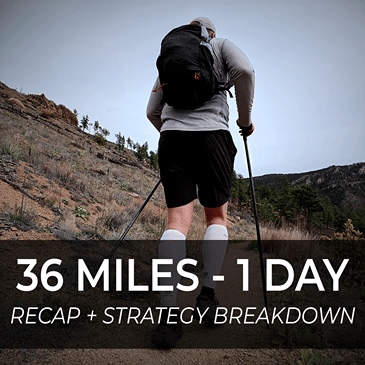
Outdoor Vitals founder Tayson Whittaker and OV content coordinator Caden covered the final 36 miles of the Colorado Trail in one day, from the Buffalo Creek area to Waterton Canyon outside Denver (Segments 1 through part of 3), in about 10.5 hours. Going in fall instead of summer, they averaged just under 18 minutes per mile including stops, refilled water once, and stopped less than an hour all day.
On this Live Ultralight Podcast episode, they break down training, gear, food, water, and pacing for a 36-mile day, and what they would change.
QUESTIONS ANSWERED IN THIS EPISODE
What is the best time of year to hike the Colorado Trail from Waterton Canyon? Outside of summer, if you can. The exposed burn area and the roughly 8-mile road walk through Waterton Canyon get hot and dry in summer. In fall, under overcast skies, those miles were cool and easy on water. In summer, Tayson would hike them very early or late at night.
How much water do you need for a 36-mile day on this section? The amount will vary greatly based on weather. For Tayson and Caden, they both carried around 3 liters at a time, filtering once because it was cool and overcast. On a hot day, it's good to keep in mind there are multiple long water carries (10+) miles. Being ready to carry 4 liters at a time is not a bad idea.
What gear do you carry for a 36-mile day with no sleeping gear? Food, water, a first aid kit, a headlamp, gloves, a rain jacket, a wind layer, and enough insulation to stop for a while if someone gets hurt. Tayson carried wind pants, a wind jacket, a rain jacket, a Vario Jacket, and a Garmin. Caden carried a Nebo Windbreaker, a rain jacket, and a Pursuit Hybrid Fleece.
What food do you bring for a one-day ultra-distance hike? Food you know you will eat, in small portions you can reach without stopping. Tayson carried a little over 3 lb of food including drink mixes and aimed for calories about every hour. Plan for variety in taste and texture so you do not get sick of it late in the day.
How do you pace a 30-plus mile day on trail? Hold an effort level, not a watch pace. We stayed around a 6 or 7 out of 10: hike the climbs, jog the flats and downhills, and check mileage targets like where you want to be by lunch.
How do you avoid blisters and foot pain on a 36-mile day? Use shoes with enough cushion and miles left, dial in your lacing before the trip, and pre-tape hot spots. Tayson's tip: tighten the upper laces slightly for long descents and loosen them for climbs.
Can you hike 30 miles in a day without running? Yes. Walking about 3 mph or faster and limiting stops, this 36 miles would take roughly 12 to 13 hours instead of 10.5. You trade speed for more hours on your feet.
CHAPTERS
0:00 Finishing the Colorado Trail: the last 36 miles into Denver
2:01 The route: Buffalo Creek to Waterton Canyon, Segments 1 to 3
2:47 Why we hiked this section in fall instead of summer
3:37 How we trained for a 36-mile day
7:25 Gear for a 36-mile day: safety layers and essentials
9:30 Caden's gear and the Pursuit Hybrid Fleece
12:26 Food strategy: calories every hour on the move
15:08 Hydration: drink mixes, salt, flasks, and a bladder
15:56 Eating for one big day vs multi-day trips, and avoiding food fatigue
21:01 Starting at 7:30am: cold hands and why gloves matter
23:02 Pacing a long day by effort level, not watch pace
25:48 The first half: rolling hills and the exposed burn area
26:49 Unexpected water situation - going 20 miles on one fill
29:20 The long downhill, hot spots, and a lacing mistake
30:55 Lunch at the river: our only water stop
32:22 The big climb: 1,200 ft after lunch
33:57 Headphones and audiobooks for long days
36:13 Descending into Waterton Canyon and the road walk
40:35 Finishing 2 hours ahead of plan
41:30 The best way to hike this section of the Colorado Trail
43:38 Caden's takeaways: shoes, training, and what a big day unlocks
47:46 Tayson's takeaways: undertraining and lacing for climbs and descents
51:52 Can you do a 30-mile day without running?
58:41 Finishing the Colorado Trail next summer and the OV 100
59:44 Black Friday sale and the Live Ultralight Membership
GEAR FROM THIS EPISODE
Skyline 30 Fastpack: https://bit.ly/3X5QL7y
Pursuit Hybrid Fleece: https://bit.ly/48EPPcN
Nebo Windbreaker: https://bit.ly/3WPiLfD
Vario Jacket: https://bit.ly/4f6RknJ
Have questions for us? Send us a voice message on Speakpipe: https://www.speakpipe.com/LiveUltraLight Or write in to support@outdoorvitals.com!
[00:00:00] [SPEAKER_00] Hey everybody, welcome back to the Live Ultralight Podcast powered by Outdoor Vitals. Today we have our content, what is your title? Content. Content coordinator. Content coordinator on the podcast and we are going to be breaking down a effort that we just did to finish the Colorado Trail down into Waterton Canyon which is right outside of Denver. Now we did the Colorado Trail backwards for most people. We started in Durango and went up to Denver. However, this year we had to skip a section.
[00:00:29] [SPEAKER_00] Due to a fire and so we did 100 miles and then that left us this kind of awkward 36 mile section that would go down into Denver. So, decided that since we were over there in that area for a business conference that we may as well get that 36 miles done because otherwise it was going to be kind of hard. It's the farthest for us to travel to from the office and it's a short section. And quite frankly, some people would say it's the least favorable section, but we're going to tell you how to do it.
[00:00:58] [SPEAKER_00] The best way. We've now figured it out in our one attempt and it was awesome. So, Caden, welcome to the podcast. Thank you, thank you. Pretty sure you've been on here at least a few times before, but how you feeling today? Feeling great. Yeah? Feeling good. You feel like you recovered from this 36 miles in a day?
[00:01:18] [SPEAKER_01] Mostly. I've had a weird thing where I felt pretty fine and then on the day when I probably should have recovered for one more day, I started running again. Yeah. And then my legs have just continuously been sore because I keep doing that. Yeah.
[00:01:32] [SPEAKER_00] So, we're good. I know what you're talking about in terms of like after ultras, I felt that where I like tried to get back into training. It's like this like deeper fatigue than just a normal effort or big effort. So, yeah, I definitely get that. But glad you're feeling pretty good. Feeling like you could go do this again tomorrow? Maybe give me three days. Yeah. I definitely need some more time, but I've also been doing some other stuff this week that has me quite sore. So, all right.
[00:02:02] [SPEAKER_00] So, in this episode, though, we wanted to just walk you through, you know, how we prepared, what we showed up to the trail with in terms of gear, and then just how the execution and the day went and the stories that went along with it. So, for those of you that are familiar with the segments, this would be essentially sections one through part of three. We started at Buffalo. I don't think it's Buffalo Creek. I think it's just Buffalo Campground.
[00:02:27] [SPEAKER_00] We ended at kind of a random spot there on our summer hike back in July. And so, we drove. We had essentially a shuttle driver. Des drove us out there, dropped us off. So, we would be 36 miles into Denver, and then we were just going to hoof it all the way to Denver. So, we're lucky in that sense.
[00:02:48] [SPEAKER_00] And we also very purposely wanted to do this not in the middle of the summer because we've heard from about everyone when you talk to them that are, like, doing the full trail continuously that started in Denver. They all are like, oh, my gosh. Like, once I got through that first section, once I got through Waterton Canyon, you know, then things got a lot better. And they just talked about how hot it was and pretty dry and all those things.
[00:03:12] [SPEAKER_00] And so, my hope when I was like, oh, I think I'm just going to try to do this in a day was to do this not in the middle of the summer and make it a little bit more enjoyable. But with that, we were watching weather because there was some storms that came in. We weren't sure if we'd be running in snow or what the conditions were like. But thankfully, it really worked out for us.
[00:03:35] [SPEAKER_00] So, to back up just a step here before we get into the trail itself, I might accidentally call this a fast pack throughout the episode. It's not necessarily a fast pack because we didn't have sleeping gear with us. This was more of just a big day effort, although we did use fast packs and we'll walk through gear in a bit. But as far as preparations go, yeah, I guess walk us through a little bit, Katie, and what you did. And then I'll explain what I did to prepare for this.
[00:04:04] [SPEAKER_01] Yeah. So, I mean, knowing that it was going to be one day and that we were going to spend a certain amount of the day running, a certain amount of it hiking. I wasn't too worried about getting backpack miles, obviously. With the Colorado Trail, I tried to do some rucking so that I could have my legs strong enough. But with this, mostly just did running. A lot of it was on the street, but usually doing like five to seven miles a couple times a week. With a decent hill in there.
[00:04:34] [SPEAKER_01] Yeah, with a pretty significant hill. And our base elevation is around 5,500 to 6,000 feet. And then I would try to get on the trail when I could, but the problem was that we kept having storms. So, rather than slip around in the mud and mess up the local trails, I opted for the road. As far as other preparation goes, I kept, I didn't really like my shoes.
[00:05:02] [SPEAKER_01] And so I kept looking for alternatives and insole alternatives and procrastinated a lot. And my insoles didn't show up until the day before we left for the trip. And I quickly realized it would not work. So, I went back to the shoes that I didn't like. And just pre-taped and didn't get any blisters.
[00:05:26] [SPEAKER_00] Yeah, I should have pre-taped, but we'll get to that. Yeah, I mean, I think there's value in this. I mean, if you're listening to this, I think the value in this is really going to come in just terms of, if you ever wanted to go do something like this, how we prepared and executed it. I think there's a lot of value in the sense of, for me, this wasn't my first effort of this kind. I've done rim to rim to rim a few times, which is about 50 miles in a day. And done some ultras and some different things.
[00:05:52] [SPEAKER_00] And so for me, I just kind of can default back to what's worked for me in the past. And what's cool about doing a big effort like this is you push, you learn, and you're better off for it because you can go and do it again. So, for me, preparation-wise, I just leaned towards some of that stuff that I've done in the past in terms of the gear. But I knew it was going to be a grind physically because I've been doing a lot of backpacking.
[00:06:17] [SPEAKER_00] I've been out of the office a lot, and I just haven't been able to, you know, quote-unquote train like I normally would for a big, big effort. So, yeah, I got out on the trails a little bit, got on the treadmill a little bit, and then just tried to rely on some base fitness. But really, historic knowledge, I guess, was more of my preparation. And that was definitely the concern going into it was, you know, the last big effort that we did was when I popped my Achilles out on the Colorado Trail.
[00:06:45] [SPEAKER_00] And then since then, I've done a lot of hiking, but not really any running and no, like, 20-mile days. It's all been, you know, maybe 12 miles at the most in a day. So, yeah, like, popping the Achilles obviously took me, like, out of commission for a month, month and a half. Then I started doing more and more hiking and then really only ran a few times before we did this.
[00:07:10] [SPEAKER_00] But, you know, our plan going into this was to treat it like a fast pack in terms of our pacing. So, hike the uphills, you know, jog the flats and the downhills that make sense to jog and just kind of go on a relative effort level. So, let's walk through gear and then walk through food and then we'll walk through kind of how the day went.
[00:07:37] [SPEAKER_00] So, as far as gear goes, like I said, we weren't having to carry sleeping bags and, you know, tents or anything like that. So, really, it's just food, water, and the gear that you wanted for that day. So, I always am going to bring, like, a first aid kit. And so, that's kind of first in my bag. But I've done trips like this where, you know, you might have to stop for a substantial amount of time or you might have a storm come through.
[00:08:04] [SPEAKER_00] And we're totally, like, there's nothing between us and Denver in terms of being able to stop or have, like, support. So, I like to bring some extra insulation. So, I brought wind pants. I brought a wind jacket. I brought a rain jacket. And then I also brought a Vario, which is a synthetic insulation piece.
[00:08:29] [SPEAKER_00] And the reason I do that is just, like, what if Caden twisted his ankle and we no longer could move quickly or we needed to kind of shelter in place for a little bit? But I've always found that I like to have things like that available when I'm solo out there. When I do the Grand Canyon, I take sometimes even more layers because I've been in the Grand Canyon in some pretty nasty storms and, you know, 40-mile-an-hour winds. And you stop for a few minutes and you are freezing. So, that's something to keep in mind.
[00:08:57] [SPEAKER_00] Yes, that's a little bit more layering than, like, a runner would do. But I always feel better having, you know, a pound, pound and a half of extra insulation, per se, for safety purposes in case there is something that's going to happen. I always carry a Garmin. And, yeah, I mean, other than that, just I'm trying to think if there's really anything else to specifically call out.
[00:09:26] [SPEAKER_00] But, again, that's kind of my mentality going in for the gear that I'm picking. Anything change with gear that you'd brought?
[00:09:35] [SPEAKER_01] Like, for a normal backpacking trip kind of perspective?
[00:09:37] [SPEAKER_00] Well, just to alter, like, what gear did you end up bringing and why?
[00:09:41] [SPEAKER_01] I went a little bit more sparing with it. I'm a little bit more reckless when it comes to one-day activities. I kind of, I've had a lot of situations where I've just decided to be dumb and plan on, like, nine miles, ended up doing 16 or that kind of a thing. And so, I need to fix my mindset. I'm kind of stupid sometimes when it comes to my trail safety.
[00:10:10] [SPEAKER_01] But, I didn't have thermals. I brought them on the trip and then the morning or the night before I decided not to put them in my pack. But, I did have a windbreaker, my rain jacket because we knew it might rain. And then, I just had a pursuit hybrid fleece. And, for me, the pursuit and the knee bow usually go together pretty well to warm me up. I'm a pretty warm-bodied person.
[00:10:37] [SPEAKER_01] And so, it doesn't take much for me to warm up. I don't think I had my Vario. But, outside of that, just the typical stuff, I also had a med kit, headlamp. I had gloves, which I was really grateful for, obviously. Yes, gloves, definitely. Gloves are huge, especially in the morning. Yeah.
[00:11:02] [SPEAKER_01] Had a really lightweight little bathroom kit for your shovel and everything. And then, obviously, just my food, electrolytes. And then, I did bring one of those little tubs of squirrels nut butter. It's just anti-chafe butter. When you're running that much and moving that much throughout the day and getting sweaty and dirty, then it really sucks when you're halfway through the day and you're chafing bad, you don't have any way to fix it.
[00:11:32] [SPEAKER_01] So, I was like, all right, I got to have that. And then, sunscreen. So, yeah.
[00:11:37] [SPEAKER_00] Yeah. Definitely had sunscreen myself, sunglasses, hat. We ran in shorts and altitudes. For shoes, I was still using the speed goats. I use insoles. And then, I did use toe socks. Toe socks definitely work better for me. But, they're not bulletproof. But, yeah. Toe socks as well. Okay.
[00:12:00] [SPEAKER_00] And maybe some context here, too, is this trail starts off at around 8,000 feet or maybe just under 8,000 feet. Our high point of the day was going to be about 8,000 feet. So, it's not super high country, which obviously means the temperatures aren't going to be as cold and drastic. When you get a storm coming through, it's not as punishing as when you're up on the high peaks. So, something to note there as well.
[00:12:25] [SPEAKER_00] Food and water-wise, this one was kind of a surprise from preparation to execution, I would say. But, I, you know, because we weren't running the whole time, but we did want to stay efficient. So, when I plan these, really it's more about measuring your stop time than your move time. Because, your goal here is just to be moving almost constantly. And so, the goal is to have a lot of food that is really easy to eat on the go.
[00:12:54] [SPEAKER_00] And, we planned really just to eat or stop for a lunch break and everything else would be on the go. So, my lunch was very similar to what I would eat backpacking. It was, you know, like jerky. And, I actually brought like Smuckers peanut butter and honey. And then, you know, trail mix and things like that. But, most of that was fairly normal food. But, then the other food that I brought is all quick calories.
[00:13:20] [SPEAKER_00] So, you know, fruit snacks, dried mangoes, bars that are, you know, that I've enjoyed eating on the go. I had some protein bars as well as like the almond, you know, almond nut butter bars. And, then, man, I mean, that's, I mean, then I bring usually some like peanut butter M&Ms or some things like that. But, I bring a lot of them in small quantities.
[00:13:47] [SPEAKER_00] And, then, the goal is that I can take all those and put them up in the front of the fast pack so that I can eat them while we're going. Usually, in efforts like this, I'm trying to have some form of a calorie at least every hour. Now, backpacking, I can get away with maybe every two hours. Running, it's like every 30 minutes. And, so, I kind of went with planning on eating something about every hour of the effort.
[00:14:13] [SPEAKER_00] And, for the pacing that we were anticipating, I was thinking, you know, with stops and climbs and all those things that we'd probably average like a 22 and a half minute pace. When we do like an OV100 hike with all of our stops, water filtration, lunch, all of that. If we never stop the watch timers at all, we're usually like 28 to 30 minutes a mile. And, then, like some of my ultras, you know, you're under 20 minutes a mile, like all in.
[00:14:43] [SPEAKER_00] So, like I'm a 100 miler. I probably averaged like 18, 19 minutes a mile. So, I was like, oh, 22 and a half was probably a realistic pace for the conditioning I'm in and being fully self-supportive, not having aid stations or things like that. But, yeah, that's kind of the strategy. So, I ended up bringing – I brought a lot. I brought – I think I threw it on the scale and I had like a little over three pounds of food that did include drink mixes. So, drink mix-wise, I brought a lot of scratch hydration mixes.
[00:15:12] [SPEAKER_00] They have calories in them. So, they have like the – I think it's called maltodextrin, which is really easy to digest carbohydrate. And then, obviously, it's got salt in it. And then, I also brought salt pills in case I needed those because sometimes I just want to drink water and only take in salt as I feel. And that's worked really well for me over time. I've kind of learned when I'm too salty or undersalted. So, did that as well.
[00:15:41] [SPEAKER_00] Planned to have two flasks that the Fastpack comes with as well as one two-liter water bladder in the bag. But that was more or less my food. Any deviations for you in food? I would – just a little bit.
[00:15:58] [SPEAKER_01] Pretty similar. I think the main thing for me was just the difference in mindset between backpacking and this and just running in general. So, when I'm running, I have some sort of food in my pack as a just in case. Like when I'm trail running. Just in case I get really tired or I really need something to eat.
[00:16:25] [SPEAKER_01] When I'm backpacking, I'm really careful with my calories in the sense of I overestimate my calories because if you're going out for five days and you don't bring enough calories on the first day and then you don't have enough on the second day, then it starts to really add up. With a push like this, I knew that it was like, okay, this is one day. I'm less worried about counting my calories because I know I'm not going to be able to get enough.
[00:16:51] [SPEAKER_01] And I'm more worried about what am I going to be able to eat constantly that's going to help me avoid hitting a wall. Because in backpacking, you have goals that you want to meet, but more often than not, at least from my experience, if you're a couple miles short in a day, you can usually still find a campsite. But with something like this, it was just, well, we got to finish it today. So, I can't really afford to hit a wall. I just got to know what I'm going to be able to, what I want to eat.
[00:17:20] [SPEAKER_01] And I know I'm going to have to just bring enough that I can eat consistently and not hit a wall. So, for me, I did pretty similar stuff. I had trail mix. I had these little peanut butter cracker things. Trail mix on that in one side. And then on the other side, I had like peach rings and nerds clusters. Yes.
[00:17:44] [SPEAKER_00] Those are phenomenal. I also had those. Those are a win for any race that you do. Mine were a little old though. They were, they like took me a while to get through each one. So, get some fresh ones for you out there.
[00:17:55] [SPEAKER_01] Yeah. They're kind of, they're kind of the super, the super thing. When I did the, when I did the marathon a year or two ago, I had gummy clusters and I'll tell you what, I prefer those over gels any day. You know? So. Yeah. So, yeah, I think that's the big thing is just find things that you know you actually will eat and that you can eat all day. And then stuff that is not going to upset your stomach.
[00:18:23] [SPEAKER_01] Because the more you're moving, the more likely your stomach is to have issues. And so if you have weird junk that you're putting into your body.
[00:18:32] [SPEAKER_00] Gummy clusters are not weird junk. They're not weird junk. Just making sure it's there. They're angelic.
[00:18:36] [SPEAKER_01] Saying like, if you got these weird, weird textured whatnots that you normally wouldn't eat.
[00:18:41] [SPEAKER_00] Like to your point though, like even like the gels, right? Like the goos or whatever. Like while like scientifically those are amazing. If you've never used them, had them, you know, like don't have experience with them. Then they're, they can be a variable. Maybe the gel you're using has a ton of sodium and a ton of salt in it. And you don't even realize it starts to upset your stomach or, you know, so just proven stuff.
[00:19:03] [SPEAKER_01] Yeah, for sure. And so kind of along with that, the other thing that I kept in mind was it's going to be hard. The more tired you get of a food, the harder it is to eat it. And when you need calories, that's a big deal. And so I tried to plan, I tried to get in the mindset that I was going to be on the trail when I was at the store. And so I was thinking about, okay, at this point in the day, I'll be totally satisfied having these four things.
[00:19:30] [SPEAKER_01] And then later in the day or during lunch, I need to break it up with a little bit of beef jerky and this bar that's completely different texture and taste than anything else I have in my pack. And I'm going to have this thing that's salty. And then for the second half of the day, I can go back to pea trings and this stuff. And so that was kind of the mindset I had of like, okay, where am I actually going to be? What am I going to be craving at this part of the day?
[00:19:59] [SPEAKER_01] And then because it's one day, it's a lot easier to really plan that out.
[00:20:05] [SPEAKER_00] Yeah. We need to mention this too. This was going to be your longest, biggest effort. This was your personal record, your PR. You've done some, well, apparently you've done a marathon. I didn't even realize that. You've also done some kind of DIY stuff where you hit like 31 miles. Yep. So this was going to be 36-ish miles. It ended up being 36 miles, I guess. But at first we were thinking it was going to be 40.
[00:20:33] [SPEAKER_00] And then we mapped it out and it said like, I think 35. 35. So we knew it was going to be somewhere in there and it was for sure going to be a personal best for you. So, but again, it sounds like, you know, you've got some experience in this and I feel like that's the big key is just experience. You know, you know, your own body. I think variety is a great way to look at it. Variety, quick, easy things to grab. Those are two big wins for sure when it comes to planning food. Okay.
[00:21:03] [SPEAKER_00] So, yeah, let's talk about how the day went. We got out there just a little bit later than we thought. We started the trail at 730. It was definitely cold. I started the trail with gloves. But for me, pro tip here is I would rather have gloves than like thermals on my legs. My hands get way colder than like my legs do or whatnot. So gloves is always a good one to have in the pack. Yeah, it was shaping up to be a great day.
[00:21:33] [SPEAKER_00] It looked overcast. It looked like we might get rained on, but it shouldn't be a substantial storm. Shouldn't be an all-day storm, which means that we had like perfect conditions for what we were doing. You know, for the most part, we weren't going to be in direct sun. And again, we'd heard this section of the trail was just really hot and dry. We also started the trail with essentially three liters of water between, you know, each of us were about three liters of water. You might have been a little under. I was probably right about three.
[00:22:05] [SPEAKER_00] But yeah, I mean, how would you, I guess, walk us through your mindset starting out the trail and how things started?
[00:22:12] [SPEAKER_01] Um, I think, I can't remember. I think when, when we started, my mindset was in, um, okay, let's, I mean, we're fresh. Let's start the day at a good pace. But in the back of my mind, I wanted to make sure that we were going at a, I knew we both knew we were going to slow down throughout the day. That's just kind of a, a given when you're doing a 10 hour push or a 12 hour, 13 hour push. Um, but I did start out thinking like, okay, this is, this is a good pace.
[00:22:41] [SPEAKER_01] I think we can keep this up for a long time.
[00:22:43] [SPEAKER_00] And yeah, we talked a little bit about the pace, right? Cause it's like, you start something out like that. And some people just take off, like they want to go as fast as they can. Other people maybe start slow and build, you know? So I just kind of, I, I guess I got to choose the pace on this one a little bit more. Um, and so my, my opinion on how to like pace something like this is to pick more of an effort level than an actual like what, like pace on your watch. Right.
[00:23:12] [SPEAKER_00] So you can sit there and watch, look at your watch constantly and try to like hold a certain pace. Well, a pace on the watch doesn't, you know, factor in for uphills, downhills, trail conditions, all those things. And so what I've found over the years to be really helpful is to pick, pick more of what I consider like a, an effort level. And so, you know, if 10 is like, you're sprinting, you're maxing out. And one is like almost no effort.
[00:23:37] [SPEAKER_00] I think I told you that I like for something like this, I would say we need to stay at like a six or a seven effort pace, which means that, you know, if you start going downhill, you just, you start jogging and, and, you know, flat. So you can usually jog. And then if it's uphill, you just go back into a hike. And so, so one of us isn't necessarily just like trying to hold some, some like watch pace, some real pacing. Instead, you're just trying to settle into an effort level and just hold, be able to hold that effort level all day.
[00:24:07] [SPEAKER_00] So that's kind of like, I told you that out of the gate. How did that translate to how you felt like things went? Like, was it kind of weird or awkward to figure out how, like when we were running and when we were walking or.
[00:24:17] [SPEAKER_01] I think it was pretty good. I think focusing on just keeping up a certain effort is a really solid goal. Um, for me, a lot of times it just helps to be like, Oh, at this point in the day, like when I reach halfway through the day, this is how many miles I want to be yet. And then if the pace isn't up to that, I'm not necessarily watching my watch and saying, all right, we need to speed it up by 0.427 miles per hour or anything like that.
[00:24:46] [SPEAKER_01] It's more of just like, okay, if we want to reach our goals, we need to be at mile 18 by lunch, or we need to be at this, this time by, by around two o'clock. Just so that just kind of a ballpark. And then when I do that, then it, it helps. Cause then every once in a while, when you do look at your pacing, you can be like, okay, at our current pacing, we are going to get home at this time. And then you can kind of be like, okay, we need to speed up a little bit or that kind of thing.
[00:25:15] [SPEAKER_01] And just, just kind of gauge it. Um, I think one of the things that really was in our favor was because the weather was so nice. We didn't have to really take a ton of breaks. And I think that's the biggest thing that wrecks your pacing is when, you know, we, we took one true break, I would say. And it was a 40 minute lunch break, but that 40 minutes offsets a lot of things. So, yeah.
[00:25:42] [SPEAKER_00] Yeah. So I guess we'll get, we'll kind of walk our way to lunch, I guess. Um, yeah, so we started off like, it was pretty much just rolling hills. No, like big climbs, no super steep climbs, just, just kind of a constant roll to the terrain, just up and down little drainages and hills. It's pretty. Um, yeah, it was, it was really pretty. The, the fall colors were, were kind of popping in some certain areas.
[00:26:08] [SPEAKER_00] The overcast skies helped it to not like just be, cause parts of it would have looked pretty dead. Yep. Um, around probably 10 o'clock or so we, we popped out into this area that was, it was clearly like a burn, but it also been pretty cleared out. And it was just a couple of miles of like a ton of exposure.
[00:26:26] [SPEAKER_01] Yeah.
[00:26:27] [SPEAKER_00] I could see how in the summertime that would have been like a really draining section where it's just like, everything looks dead and everything looks, you know, it's just super hot. The sun's beating on you. But for us, it was fairly overcast and it was kind of pretty, I guess, because of that.
[00:26:41] [SPEAKER_01] Yeah.
[00:26:42] [SPEAKER_00] You could, you could look off in the distance and see some snow on some peaks or, or some rock formations. And it was, it was definitely more enjoyable. We also, you know, I had, I had tried my best to kind of map out water and this is, you know, this was like, you know, you can only go off of past efforts to, to gauge stuff like that. And usually I drink a lot of water, even when we're hiking, I tend to drink like at least a liter of water per hour.
[00:27:11] [SPEAKER_00] And then when I'm running, especially like in summertime, I can go well above that, almost a two liters of water an hour. And so I had tried to flag a few spots where we could get water that I thought would be appropriate distances. If we were carrying, you know, uh, three liters of water. Well, we got going and we just, we really weren't having to drink very much water. And I was like, well, there's a 10 plus mile section with zero water. Um, so let's just make sure we get water at this last stop.
[00:27:41] [SPEAKER_00] And we just kept cruising along and I'd ask Caden how he was doing on water. Cause I wasn't drinking all that much and we passed the last stop. So we literally got in and we're like, okay, I guess we're going 20 miles before we do a single water resupply. Um, I got a little bit nervous when I realized we passed it. I was like, oh boy. But, but both of us were like, we feel hydrated. We don't feel drained. And we still had quite a bit of water, even 10 miles in.
[00:28:11] [SPEAKER_00] Um, and so it's just another one of those situations where you realize that time of year, heat, sun exposure, um, drastically changes how much water you end up drinking. Right. So, um, water wise we, yeah, first half of the day, we, we literally did not fill up water until we got to lunchtime. And that was, if I remember right, it was 19 point, like six miles into the day.
[00:28:39] [SPEAKER_01] Yeah.
[00:28:39] [SPEAKER_00] Um.
[00:28:41] [SPEAKER_01] With two and a half or three liters. Yeah. Yeah. Crazy.
[00:28:44] [SPEAKER_00] And we both got there with water still in our packs.
[00:28:47] [SPEAKER_01] Yeah. Yeah. I never, never felt like I was, um, what is it called? Rationing either. So it was good.
[00:28:57] [SPEAKER_00] Yeah. It was a big change because on like ultras that I've done, I have been, I have calculated, like tracked it and I've drinking up to like 15 liters of water throughout a day. So it was, it was pretty surprising to me, I felt like, um, but that's a good sign. Like that was like, again, one of the reasons why like us doing it this time of year ended up being phenomenal. Like it was, it was perfect. But, um, overall though, we were keeping a really good pace before we got, like we had some big downhills.
[00:29:27] [SPEAKER_00] We only had one big uphill. And so before lunch, we had a pretty long downhill. We ended up running for quite a few miles, um, down. We got a little bit nervous. We got towards the bottom for a couple of reasons. One, you just never really know if you're going too hard on a downhill, if it's like a really long downhill. Cause you can get to the bottom and just like realize, oh my goodness, my legs are like blown out. They're like jello. Yep. Um, but also I was starting to get some hotspots in my feet. So I tightened up my shoes at one point, trying to make sure I didn't get any blisters.
[00:29:57] [SPEAKER_00] Um, that ended up being perhaps a mistake because I did get blisters. And then I also like hurt the top of my foot because I went like too tight on my lacing. And that bothered me the second half of the day, but overall really smooth. First half of the day, really pretty, some really cool rock formations, especially the first like five to seven miles of, of that section there. Yeah. Um, but yeah, it was going really smooth and pretty much no one out on trail.
[00:30:25] [SPEAKER_00] We passed a couple people by lunchtime that were day hiking.
[00:30:29] [SPEAKER_01] Yeah. We probably looked like a, a team or something. Cause we both were wearing the same clothes.
[00:30:36] [SPEAKER_00] We always end up on trail with the same clothes. Uh, imagine that. I mean, we have five colors of altitude hoodies and we end up wearing the same altitude hoodie color and gray hoodie, black shorts, same hat, black gloves. Yeah. I was leaving like, oh, I'm going to wear the new fast pack color, the blue one. And I had the blue one fast packs. It's just like, man, can't win. And so, yeah. Um, yeah, we got down to lunch at lunch is when like, that was when we filtered water. That's the only time we filtered water. So we filtered water.
[00:31:06] [SPEAKER_00] Um, I took off my shoes and kind of relaced a little bit. And then we had our lunch and it's just amazing how fast time ticks away. Prior to that, we had literally stopped one time for a bathroom break and we didn't really stop. I sent Caden down the trail. I stopped and it was maybe a five minute, um, potential stop there. Yep. Um, and then we stopped for 40 minutes for lunchtime in the bottom of this canyon by this really pretty river. Caden loved that section.
[00:31:34] [SPEAKER_01] It was so good.
[00:31:35] [SPEAKER_00] He definitely commented a lot on how much you, how pretty you thought that section was.
[00:31:39] [SPEAKER_01] Yeah. I, I love rivers, especially being in Southern Utah. Um, I'm from Northern Utah, but being in Southern Utah, it's a very dry down here. And so when you get the chance to have like a lush green or what's normally green, it was, it was mostly orange and red. So it was just, it was pretty and it felt, felt good to be by the water. And I think we were both relieved that it didn't taste like fish cause it smelled like fish.
[00:32:04] [SPEAKER_00] Yeah. I was nervous. I was actually quite nervous. I asked Caden, I'm like, taste that water just so we know if I need to like put some, uh, flavoring in all of my water. But you did anyway. I did end up doing a, I kind of regret it, but I did it anyways. Um, so yeah, had a good lunch. Uh, we knew that we had one more substantial climb in the day is about a 1200 foot climb overall throughout the entire day.
[00:32:32] [SPEAKER_00] We were going to climb around 31, 3,200 feet. And then we would net descend about 5,000 feet. Um, so like, I mean, trail conditions wise, we were on really good trail and we were net losing on the day. Um, and we weren't at high altitude. So we had one big climb after lunch. Um, that went on a while. It was like a three plus mile, maybe three to four mile climb. That's a good climb. Um, about 1200 feet.
[00:32:59] [SPEAKER_00] So nothing crazy steep, but just, you know, four miles almost of, of straight uphill is, it starts to drain you. Um, but thankfully had cloud cover, had food in our belly at that point, which is kind of a, uh, good and bad thing to do. Your height, uh, to do an immediate, uh, climb on. But, um, yeah, overall though, trail is pretty much a mountain biking trail through this entire section.
[00:33:28] [SPEAKER_00] So trail conditions were really good. It wasn't like you're going through wilderness with just boulder fields and rocks and stuff like that, which definitely helped our pacing. Um, and we were ahead on pacing. Like I said, we were kind of planning for like 22 and a half minute miles. By the time we finished lunch, we were a little over 18 minutes per mile on average. But when we stopped, we were still under 16 minutes per mile. So we were feeling really good on, on pacing. And I mean, it's just a, it's just a good day on trail.
[00:33:57] [SPEAKER_01] Yeah. Honestly, it was, it's probably the best day we could have asked for. It rained just a little bit, but that wasn't bad at all. Never felt like I wanted to put on a jacket. Or anything like that. Um, I think normally when I'm doing a trail, when I'm backpacking or a lot of times when I'm hiking, I don't like to put on music or anything. I don't like to listen to anything because I just want to use the time to focus on nature.
[00:34:24] [SPEAKER_01] But I, uh, I will say there's some stretches where I was really glad that I had headphones because even though it gets, it's still really pretty, I think sometimes when you start to get more tired or you start to hit those walls, being able to just have something else to focus on is really good. So if you're one of the people that likes to focus on nature entirely, I'd still recommend buy some cheap headphones that you can throw away and, or just buy ones that are connected to each other.
[00:34:54] [SPEAKER_01] So you won't accidentally drop them and lose them and then make it a priority for these day pushes. Cause it's, it's handy. Listen to an audio book, listen to some music.
[00:35:03] [SPEAKER_00] So, yeah, I think both of us put in, uh, put on our headphones, um, after lunch for a bit on that climb. Um, I was listening to an audio book for a bit of that. And, um, I mean, still my favorite headphones to use on trail, especially if it's not like an extended multi-day one where you got to worry about recharging them and stuff like that, um, is the bone conductive headphones. They just kind of sit on the outside of your ear and, um, they're super nice because you can
[00:35:30] [SPEAKER_00] still hear people around you, wildlife around you if you bumped into something. Um, but you can, you can kind of, like you say, focus on something else when it's some of those pushes, because no matter how you do a 36 mile day, um, there's, there's some discomfort to it. And there's times when you just kind of want to zone out and get the miles, um, clicking off and, and just kind of hit a different state. Now you can definitely do that with, with music or with an audio book.
[00:36:00] [SPEAKER_00] Um, or just, you know, kind of finding your own flow or Zen or, or, or something like that. And, um, but usually on a, on a big effort like this, I like to mix it up kind of like you're saying. So, um, but yeah, got to the top, got to the top of that climb and knew it was mostly downhill from there. One little climb and then like literally just miles and miles of downhill.
[00:36:25] [SPEAKER_00] Um, so we, and we were so far ahead on, on pacing at this point that started to kind of contact our, our ride driver and we're saying, Hey, just say, you know, we're, we're pacing like two hours ahead of where we thought we would be. Um, so we took, we took it a little bit easy in some sections there, like slowed down a little bit. Didn't run every downhill. Um, and I was truthfully, I was starting to feel it on some of the downhills.
[00:36:51] [SPEAKER_00] Um, at this point I knew I had a blister on, on one of my toes and, um, because I tightened up my shoe a little bit too tight, maybe earlier on, I was kind of feeling some, I mean, I didn't have a bruise, but it kind of feels like you've got like a bruise on the top of your foot over your forefoot. So, um, yeah, just wasn't like hammering, I guess, down this section, but we were still, still making good time. Um, and then, yeah, I mean, still had some great views.
[00:37:19] [SPEAKER_00] We kind of got off of the hiking trail and you've got about maybe eight miles left of basically road walking. And this is the part where a lot of people really complain about the Colorado trails because they start on like this eight mile road walk where you're going to be in full sun in a canyon that probably doesn't get very much wind and would be really, really hot. But at the top of that canyon, it's really pretty. There's this massive, uh, dam that they have built there.
[00:37:46] [SPEAKER_00] Um, and then there's just this really beautiful river that flows down and into, into Denver area.
[00:37:52] [SPEAKER_01] Super cool.
[00:37:54] [SPEAKER_00] Um, the road was really hard by that point in the day though, for your feet, like running on asphalt. It's really compact and not much variety to it. Um, so we, we walked a little ways there and then, um, essentially we're like, well, let's, let's finish strong. Let's see if we can finish this. You know, I, I mean, I kind of like to set, I like to do mental math on trail. I don't know. I'm the math guy, I guess. And so I was doing some mental math and I was looking at the watch.
[00:38:20] [SPEAKER_00] I'm like, you know, I think we could finish this at under 18 minutes per mile if we, if we run, but I also just like to finish things as strong as I can. And so we did end up, um, we'd run like one or two miles, then walk a mile and then run one or two miles and walk a mile. Um, and yeah, we finished, we finished, um, kind of in that effort. I guess one other thing that stood out to me in that Canyon was just this, we, we, we started to run into people there.
[00:38:46] [SPEAKER_00] And, um, you know, that we're coming up, you know, biking up the mountain or, or just on a little evening hike, the closer we got to Denver. And that road is, is not a public access road. It's like only a road for the Denver water, you know, conservative or whatever it's called. Um, so there's a lot of people that start coming up there. This, not many of them were saying hi to us. I kind of noted that to, to Kano and these people are zoned out.
[00:39:12] [SPEAKER_00] You know, you're so used to hiking out in the woods where everyone you see, you say hi to maybe even chat with them. They're kind of zoned out. And, but this one lady stopped us and she was, she was looking for mountain or excuse me, a bighorn sheep. And she was looking at like right off the side of the road. Like it felt like she was looking like 30 feet off the road. And I'm like, she's like, have you seen the sheep? And I'm like, no, we haven't seen any sheep. We haven't really been looking, but I don't think you're going to see them like 30 feet away.
[00:39:40] [SPEAKER_00] You know, like there's a huge Canyon here and most bighorn sheep are skittish and they're, they're away from people. And, you know, anyway, so we kind of talked to her and, you know, just told her we hadn't seen any. And as we were leaving, she's like, yeah, someone said that they were just right up here. You know? And to me, I'm like, you never know what that means. Like, did they tell you that like at work yesterday or something like that? But we got like 10, 20 steps past her. She's like, oh, they're right there.
[00:40:05] [SPEAKER_00] And sure enough, we turn around and these sheep are like 50 yards off the trail, like right there. They were right above us as we were talking and we didn't see them behind this cliff thing. So it was really cool. We stopped and talked to her a little more and looked at these, um, these sheep up there and had some, some use and, and one pretty good Ram. Um, so that was always fun to see. And then, um, but yeah, I don't know. That lady was just, she was just funny. She was really funny, a little bit quirky and just super nice. Yeah.
[00:40:35] [SPEAKER_00] Um, anyways, finished the trail in the daylight. Didn't have to pull out the headlights, headlamps at all. Yeah. And finished two hours ahead at like a 17, uh, high 17 minute per mile pace, including all of our stops. Um, I would say that with our 40 minute lunch stop, we probably did not stop for more than an hour through the whole day, which, um, it's pretty impressive. We only had to fill up water once, which blew my mind.
[00:41:03] [SPEAKER_00] That was the most shocking part of the whole day. The amount of drink mixes I brought and didn't use because we just didn't use. You know, um, was very substantial. Um, yeah, I think I used four the whole day. Yeah. I, I probably used a couple more than that, but maybe not much. Um, which is again, just surprising for me because I usually consume a lot of salt on trail and I consume a lot of liquid on trail.
[00:41:30] [SPEAKER_00] So that was a, that was a huge bonus, um, for doing it this time of year. So if you are going to do the Colorado trail, man, if that is a great section to do, um, I mean, I, I said this, I said, if I was doing this in the summer, I think I would literally do this section when the sun's not up, whether that's early, early morning or late, late night, you could probably do like Waterton Canyon, do like the first 10 miles of that, like super early in the morning or something like that.
[00:41:57] [SPEAKER_00] And then, you know, get 20 miles in and then the next morning do the same thing, like wake up really early and get through that next really hot burned exposed area. Um, but if you're, and that's how I would do it. If I was going to do it all in one push, like do the whole Colorado trail at once. If you're not doing the whole Colorado trail at once, you're doing it in segments like we did. Um, this is the best way. Yep.
[00:42:22] [SPEAKER_01] Honestly. Yeah. I think we would be having a much different conversation if it would have been really hot because we would have drunk a lot more water. We would have been a lot more tired. Um, and I also didn't see us pass very much water until we got to the main canyon. So we probably would have been a lot more dehydrated. Yeah.
[00:42:42] [SPEAKER_00] There's some big water sections. If you were going slower and it was in the middle of the day, like water would have been a real problem.
[00:42:48] [SPEAKER_01] Yeah. I mean, yeah. If you're just doing like 10, 15 miles a day, there's plenty of sections where you would not see water the entire day. Even, even where they did say there was water, we didn't, I don't remember seeing it until we got to the main river area. So, but needless to say, it was probably the best conditions we could have asked for. It was a great day. And I love the scenery because it was overcast. I think it would have been harder to appreciate it if it was really bright and sunny.
[00:43:18] [SPEAKER_01] So yeah, it was really cool.
[00:43:21] [SPEAKER_00] Yeah. I mean, if you've got quite, I'm just trying to think of like what other things we can kind of add into this to add value to you guys that are listening. But if you have questions, write those in, you can drop them on our YouTube channel or you can message support outer vitals and say, you know, I've got a question for the podcast and we'll answer those on future ask OV episodes. But, um, I don't know, just kind of bringing it back to you, Caden. So this was your biggest day. Um, like what, what takeaways do you have, I guess, to share?
[00:43:49] [SPEAKER_00] What thoughts do you have on how the day went and, and what did you not expect? What did you expect? What do you feel like is the biggest lesson learned to take into future efforts like this?
[00:44:01] [SPEAKER_01] Um, I think there's a few different things that I kind of, that kind of come to mind. I think the biggest thing for me is just be familiar with your gear, be familiar with yourself. Um, I, I did the trail. I was fine. My feet were hurting pretty bad by the end of the day, I will say.
[00:44:21] [SPEAKER_01] And so I think if I would have been more intentional with getting another pair of shoes, I think it, I still, I mean, when you're doing 36 miles in a day, your feet are still going to hurt. Cause it's just repetitive impact, but mine just didn't have that much, um, cushion, I guess. And so, I mean, I'm kind of old or were they just not a high cushion shoe?
[00:44:45] [SPEAKER_00] Both.
[00:44:46] [SPEAKER_01] Yeah. So I used them on the, I use the same ones I used on the Colorado trail, like the hundred miles. We did. Yeah.
[00:44:52] [SPEAKER_00] So there's still good shoes, but yeah. Knowing you, you probably put a couple hundred miles on them with training and yeah. And that then.
[00:44:59] [SPEAKER_01] Yeah. So there's still a great shoe. They still had plenty of tread left. Um, it was mainly just like, I knew coming out of the Colorado trail that they were going, that I was going to have foot problems. And I did. And so if you've got the means for it, just it's worth making sure that you're, you got the right shoes. So you don't blister so that you don't bruise or fracture your feet.
[00:45:23] [SPEAKER_01] Um, that happened to one of our team members when he did an ultra fractured his foot with like two miles left. So, um, just make sure you got the right footwear, keep your shoelaces, the tightness that you need. Growing up, I was always told you need your shoelaces to be really tight so you don't break an ankle or something. But as I started to run more and more and get into it, my preference is to keep my shoes pretty loose.
[00:45:47] [SPEAKER_01] Not to the, not to a point where they're sliding around, but if my laces are too tight, then it starts to affect other muscles in my foot too. And it makes everything harder. So, um, shoes were a big thing. And then I think the other thing is just once you do, once you do an effort like this, once you do a 30 mile day, a 35 mile day, more than that, or even just a 20 mile day, you unlock something within yourself.
[00:46:15] [SPEAKER_01] That is just really cool where everything seems a lot more possible, you know? Um, growing up, I always thought 20 miles was like crazy to do in a day. And then I did it. It was like, okay, this is great. And then I was still intimidated by it. And then I did a 30 mile day and it was like, okay, now a 15 mile day doesn't sound so big anymore.
[00:46:39] [SPEAKER_01] You know, still, still a great day, still a full day, but it's showing you more and more what you can accomplish. Now, the other side of the coin to that is after you've done different races or after you've done big pushes like this, the risk is just overconfidence or getting too, getting too comfortable with it. Because it's insane how fast your training can slip if you don't stay on top of it.
[00:47:05] [SPEAKER_01] And so even though you may have been able to do this crazy push a year ago, just, you don't want to be stressed about it, but keep yourself a little bit afraid of the big pushes because otherwise. That drives you to train. Yeah, exactly. Because the reality is like, even if you've done it before, you still got to train for it and you know what to expect better.
[00:47:27] [SPEAKER_01] But if you don't go into it a little bit nervous, then that's a higher chance of actually, actually having an issue on trail, which I did. I did a little bit this time. I, I feel like I tried to train as much as I could, but I also could have trained a little bit more for this one, but it was good.
[00:47:45] [SPEAKER_00] Yeah. Yeah. I think that's like the story of my year this year is like overconfidence. Now it wasn't, I knew, I knew like going into Colorado trail, obviously I got injured and I think that was due to lack of more training and then kind of same with this one. But unfortunately for me, I've been very intentional with my time and I've just been choosing to spend less time training and more time and energy and efforts in some other parts of my life.
[00:48:11] [SPEAKER_00] And it's hard to do that and then just come and still do some of these kinds of efforts. I was, I do think that when you've learned a lot about your own physical body and doing efforts like this, you can take that historic knowledge and apply it forward. I would say that if I had never done ultras and some of those kinds of efforts, this day would have been immensely harder. But being able to build on past experiences is definitely helpful.
[00:48:40] [SPEAKER_00] But, um, yeah, I would say I kind of went into things, not overly confident, but under trained and knew I was under trained, but didn't, wasn't scared enough, I guess is the best way to say it. To pull from other parts of my life to prioritize training. Um, I did say that I did mention this, like I did use toe socks and, and shoes that I was pretty familiar with. I did still blister.
[00:49:06] [SPEAKER_00] And that's just the fact of me not training enough, not a foot problem is how I would describe that. Um, but I think the bigger lesson there is. Like trail runners don't necessarily need to be broken in like a boot would be, but I find that the, like, after I get an initial, like 10 plus miles in a trail runner, I have like got the laces like where I want them.
[00:49:33] [SPEAKER_00] Um, so sometimes they're too loose in the, in the foot box. Sometimes they're, you know, too loose at the top or overly tight in one area. And the more you just kind of put some miles in them and then slightly tweak and adjust the laces, the more you settle into the, the foot or the, the shoe itself. So these were newer shoes. I'd probably had five or 10 miles on them, but not super steep terrain. And, um, I think that's one of the reasons I did blister was just like slight tweaks to the lacing.
[00:50:01] [SPEAKER_00] Um, I think if I would have, and this is, this is one thing I think that is valuable and can be adjusted on trail. And that is if you're going to run, um, slightly tightening your shoe on the downhill, I think is a good thing to do because your foot doesn't slide as much down and forward. But then when you go to climb on the other side of it, then loosening your shoe back up. And I'm not talking like drastic amounts, but just minor tweaks like that, um, can be well worth your time and effort.
[00:50:31] [SPEAKER_00] Like if you know, you've got a big, long downhill, go ahead and tighten the upper part of your shoe a little bit. And then if you know, you've got a big climb up ahead, like go back to neutral or even slightly loose for, for the climb. I find that works well. And most trail runners these days, they're, they're really good at trying to get the right tension, like all the way through the shoe. Um, which is why I don't think you have to like overly tighten or over, or, or overly loosen. Um, like I say, you put some miles in them and they start like forming to your foot almost.
[00:51:01] [SPEAKER_00] And the laces start to get where they need to be. And, um, that was kind of the issue I had with, with the Colorado trail this summer when I was trying out a brand new pair of shoes that I'd never worn before. Um, I blistered day one and I actually don't think it was a problem with the shoe. I think it was a problem with the lacing, but I hadn't, I hadn't worked my lacing method into that shoe yet to kind of get like, okay, this is how tight I want it here and here and here.
[00:51:24] [SPEAKER_00] Um, so do you think there's something to be learned just from maybe when to tighten, when to loosen and then settling yourself into a new shoe? Again, not so much that it's a break in of like the sole and the, the materials softening up, but almost more so just getting your lacing right where you want it to be. So your foot's either not sliding too much or it's not overly tight in, in the shoe. Um, yeah, overall though, I agree.
[00:51:53] [SPEAKER_00] I mean, doing efforts like these, it kind of has an unlock, I guess. Let me ask this question to you and then I'll answer it myself, but let's just say someone's listening to this. They're like, I don't run. Um, so I can't do a 30 plus mile day. Um, what are your thoughts on like, is that true or false?
[00:52:12] [SPEAKER_01] I think it depends on how long you want to take, because if you have a headlamp and you've got some, some mean determination, then of course you can do a 30 mile day without running. If you're wanting to hit a certain window of time, then you just have to plan on it.
[00:52:38] [SPEAKER_01] You know, like if you're trying to do 36 miles in, what would it take? It's like 10 hours. Yeah. Like 10 and a half, 10 and a half. If you're trying to do a 36 mile day in 10 and a half hours or in nine hours or something like that, then yeah, like you're going to, you're going to have to run unless you just plan on really speed walking the whole day, which is arguably just going to make you a lot tired, a lot more tired because of the muscles that you're using, you know?
[00:53:07] [SPEAKER_01] So I would say if you're, if you're willing to spend longer on trail, then yeah, you don't need to run. Um, just work the muscles, like however you plan on doing an effort like this, just work the muscles that you're going to be using, work your hip flexors, make sure that your quads, um, and your calves are good because that's just repetitive movement.
[00:53:29] [SPEAKER_01] Um, one thing to consider, and this is kind of something that we talked about on trail was, um, time, time on trail versus effort, you know?
[00:53:40] [SPEAKER_01] Um, like my feet were pretty, pretty sore by the end of the day and the idea, I mean, obviously we've been running for a bit of the day and that creates more impact, but the idea of at that point spending more hours on trail, like another three more hours on trail for the sake of not running, my feet would have been way worse. So it's just kind of a, just kind of a balance, like, yeah, you can do it.
[00:54:06] [SPEAKER_01] You just have to be ready to spend more hours on trail and therefore more time on your feet. Um, we'll say this though, if you're, if you're physically able to start running, I think it's, uh, I think it's a valuable thing to do. Um, not saying you have to, uh, if you haven't run in the last 20 years, I'm not saying you have to suddenly start with an immediate 5k and then going to like five miles and seven miles or anything like that.
[00:54:35] [SPEAKER_01] Um, but it is incredible how liberating it is. Once you do start running and the things that you start to unlock the distances that you can start to cover, how much better you feel. And then also your growth, because you might start with a quarter mile and then you get to half mile and you go to a whole mile. And then after a couple of weeks, you'll start to crush numbers that you never even thought of. And so I wouldn't start out thinking I'm not a distance runner.
[00:55:03] [SPEAKER_01] Just start out thinking that you want to improve. And I mean, I'm, I used to be a sprinter in high school. And so the idea of distance running was not my cup of tea. But then once I started to do it and started to figure out what I enjoyed about it, that it was my time to listen to my audio books. Now I just do it year round because I feel a lot better.
[00:55:28] [SPEAKER_01] And it gives me the ability that anytime any one of my friends says, Hey, you want to go do this trail or here at work? Anytime there's any sort of trail, I can completely confidently say, yeah, I'm ready for it. You know?
[00:55:41] [SPEAKER_00] So I, I heard a stat once and I don't know the exact origin of the stat or the, or the validity of the stat, but it was something like basically a high percentage. A high percentage of adults never sprint ever the rest of their entire lives after the age of like 20. And, um, I think it's just so true though. Like, like they'd never have the need to sprint after the age of 20.
[00:56:10] [SPEAKER_00] And so they're, and then if they do like the risk goes up so high, but there's this other concept of, of like, if you never stopped doing something, then you, then like you never stop. Right. Like you look at people that like live to incredibly like older ages and they still do like, like there's people, you can look up articles of people that are like running ultra marathons in their eighties or even nineties. And you ask them like how they did. And it's like, well, I just never stopped. Like, so now some of you listening to this might be like, well, I've already stopped. Doesn't mean that you can, that that has to be your forever future.
[00:56:41] [SPEAKER_00] Um, but I think that's like a mantra I want to take into like, and just in my entire life is just never stop. Like that concept of just never stop. I think is, is really, um, I think it's just, it's just really valuable. It's really interesting. Now, the way that I would answer that is you definitely could have done this 36 miles walking the entire thing. Now, I think you would have needed to have been like speed walking. You're trying to walk, you know, at a three mile an hour pace or faster the whole day.
[00:57:10] [SPEAKER_00] And then I think you would maybe even try to limit stops more if possible. Like we took a substantial 40 minute lunch break and then, yes, you're going to take more time on feet, meaning you're going to be out there longer than 10 and a half hours. You might be out there 12, 13 hours, but like that was still within a realm of possibility. We could have finished at 13 hours and been like eight, eight 30 right in the evening.
[00:57:34] [SPEAKER_02] Yeah.
[00:57:35] [SPEAKER_00] So, um, still very possible. I, I, in a years ago on this podcast, I used to do a lot more interviews and I would talk to guys that had done FKTs and a lot of them never ran, but they were doing 30, 40 plus miles a day, but they were only sleeping like four hours a night. Right. And so it's like, it's possible. Well, I've done a 30 plus mile day, um, backpacking.
[00:57:57] [SPEAKER_00] Um, I was actually out on the AT, you know, but yeah, I had to, I walked into the night quite a few hours and, and with a headlamp. So it's definitely possible to lose if you don't run. I think there's just kind of trade-offs of, of speed and ability. And, but like, yeah, you could totally do this in my mind, just walking and power walking, speed walking. And you just have to be incredibly efficient. You kind of got to get tenacious about like not stopping for things as much as possible.
[00:58:25] [SPEAKER_00] I think that's where pockets on the front of, you know, whether you add shoulder pockets to a backpack and then have big hip pockets, you know, access to food, to calories, water filter, whatever it is, is just like the most important thing to stay efficient on trail. But yeah, well, this was fun. I'm super happy that we did it because now when we go back and we do our hike next summer, that will be the last section of the Colorado trail. We'll hike the West collegiate route is the plan. And that will be the last section of the Colorado trail.
[00:58:54] [SPEAKER_00] And we'll have done all 480 miles as a team. Not everyone on the team will have hiked all 480. Thankfully, I will be the one who've done all 480 miles. But when you're the boss, I guess you get to decide when we go and do the hikes. And so you can always be there. I think we'll have some others though, that in their lifetime, we'll go do some of those sections that, that they either missed, or I think you only will have missed one. And it was the very first year.
[00:59:22] [SPEAKER_00] So that'll be a pretty easy, not terribly easy, but it'd be definitely possible for you to go knock that off someday and have finished it. But super excited. So next year we'll finish the whole Colorado trail on our OV100 hike. Now, if you want to do the OV100, stay tuned. We usually start taking signups for that in January. A couple other things. We will be doing our Black Friday sale pretty soon, if not when this goes live. But we run that earlier in November.
[00:59:51] [SPEAKER_00] So the best deals of our holiday season will be early November, around November 9th-ish. And we'll run through the holiday season. But the best deals are definitely earlier in that sale. So be aware of that. And then just want to do a quick call out too to our Live Ultra Light membership. I haven't talked about it on the podcast for a long time. But our Live Ultra Light membership is basically a store credit, a savings account for you. So it's $10 a month. You get $10 in-store credit instantly every time you're charged.
[01:00:18] [SPEAKER_00] And then you get access to the biggest discounts, whether it be on the sale or every day of the year. You get 10% off every day of the year. But on the sales, you get 15% off. And on the peak tier, you get 18% off. So there's some big discounts there. With the membership, you get other benefits. You can get into the Facebook group and ask questions and get feedback there. We have other things such as early releases that come to the membership. Or I don't know. There's a pile of things you can look up in there.
[01:00:46] [SPEAKER_00] But you also get access to our proven essentials where you can buy things like the scratch hydration mixes or peak refuel meals or water filters or all the other things that we tend to use on trail. And you're able to get those at 10% off. Plus, we give rebates on those retail items that we sell. So it's really your best and cheapest way to restock backpacking food or restock on your water filter. So anyways, go sign up for the Live Ultra membership if you are not currently a member.
[01:01:13] [SPEAKER_00] You'll get the best deals on this Black Friday sale to come as well as the best deals year-round. So if you've got questions, make sure to write them in. If you're not subscribed, subscribe. And share this episode with someone who you want to take out backpacking and crush a 30-mile day. With that, see you guys in the next episode. And we'll see you out on the trail.